Exclusive: How are ‘digital twins’ revolutionizing infrastructure?

In this interview for Construction Canada with Lindsay English, digital rail leader at Arup, we go in-depth on data fragmentation, analytics, artificial intelligence (AI), and explore what a “digitally mature” Canadian infrastructure project could look like in the future.
A digital twin is a virtual replica of a physical asset. Unlike a static model, it establishes a feedback loop in which data is exchanged between the physical and digital environments.
Can you point to a real Canadian project where digital twins or advanced analytics measurably improved cost, schedule, or asset performance?
We identified 21 examples while creating the report, and we’ve since learned of many more. A few highlights from the Future of Infrastructure Group “Unlocking Digital Twins in Canada” report include:
Asset performance: Vancouver’s Canada Line SkyTrain has a digital replica of the entire rail corridor, generated using LiDAR, ultrasonic, and other sensors. It serves as a single source of truth tied to maintenance records, remote condition monitoring, and operations data—flagging anomalies to support preventive maintenance and operational optimization. The line reports 99.8 per cent availability. Vancouver International Airport (YVR) uses a digital twin to optimize day-to-day operations and inform future planning. It visualizes the airport and ingests near-real-time data—passenger flows, aircraft movements, baggage, weather, and more—to support faster decisions and scenario planning.
Cost and schedule: The Eglinton Crosstown West Extension developed a digital twin and mobile app that lets site inspectors upload spatially tagged site conditions and photos in real time. The team also implemented a 4D scheduling model, enabling managers and technical reviewers to explore the latest schedule in a spatial/asset context and identify design–construction interface issues early. LNG Canada used AI to anticipate schedule risk by learning from historical risk factors. Based on an analysis of 30 risk items, the team identified 150 days of avoidable delay by focusing on the 0.5 per cent of activities with the highest risk. Using traditional methods, only four analyses could have been completed over the same period.
Where is AI being used today in infrastructure projects?
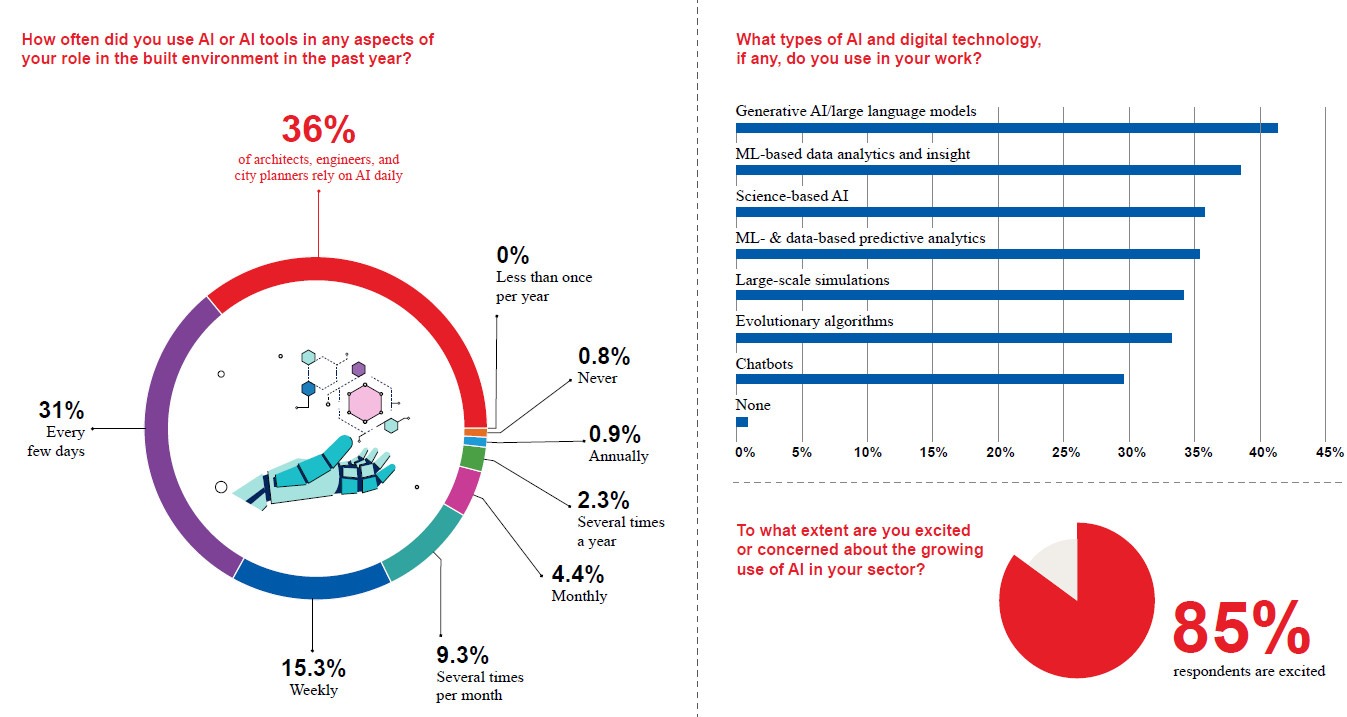
Arup conducted a global survey of over 5,000 built environment professionals in 2025 and found 36 per cent of respondents were already using AI daily.
A few examples we’re seeing in practice:
- Planning: AI can analyze large datasets to better understand environmental impacts. On the East West Rail project in the U.K., Arup used machine learning to create baseline mapping and assign habitat distinctiveness, condition, and strategic significance across pre- and post-construction habitat types. The result was a 20 times increase in the scale of data mapping, improving how biodiversity net gain was assessed.
- Design: Arup’s InForm is a generative design tool used across building and infrastructure projects. It can combine constraints and client preferences, generate thousands of viable options, and help teams refine designs in real time—accelerating early-stage exploration. As the list of design considerations grows (from energy performance to new sustainability regulations), tools like this help keep decisions both ambitious and evidence-based.
- Project delivery: Arup’s AI tool helps teams retrieve and summarize relevant information from thousands of documents, reducing time spent searching and minimizing errors. Project leaders can ask complex, project-specific questions in natural language. The system uses context to return precise answers with traceability back to source material.
How reliable are AI-driven insights when the underlying data is incomplete or inconsistent?
It is a real concern. A clear digital strategy at the project outset, defining what data is needed and how it will be used, sets direction for structured information management. The ISO 19650 standards provide a framework for how information is created, exchanged, and managed across project partners. Without those building blocks, teams end up playing catch-up, and it is difficult to use AI for project insights at scale (beyond personal productivity gains).
On the positive side, AI can also accelerate data cleanup. When major projects mobilize, thousands of documents and background materials need to be reviewed quickly, but often have inconsistent naming and categorization. AI can help classify and tag that information, so it becomes searchable for both people and automated tools.
What does a “digitally mature” Canadian infrastructure project look like in five to 10 years?
Projects would start with a lifecycle digital strategy early in planning: defining priority use cases and making procurement and delivery choices that support efficient operations, maintenance, and longer asset life after handover. Contracts would incentivize innovation and quality, timely data exchange. Information would be governed through a structured process aligned with ISO 19650, enabling “just-in-time” sharing across owners, contractors, and stakeholders. Routine workflows would be faster and more reliable. Risk would be managed earlier and more proactively. Cost and schedule overruns would be easier to foresee, safety would improve through sensors, drones, and analytics, and handover would be seamless because the required data is delivered in usable formats. Over time, individual asset twins would connect into a broader ecosystem of public infrastructure and smart-city digital twins.
Based in Toronto, Lindsay English is a seasoned technology leader who leverages her experience in transportation and the tech industry to lead Arup’s digital rail services in the Americas.
Sign up for our weekly newsletter
Construction Canada weekly newsletters give the latest AEC industry news for those who build, design, engineer, specify, renovate or operate in the built environment.
Read the Latest Issue


- CSC Hamilton-Niagara: Engineer’s View of Lime-Mortared Masonry with International Expert
- Message from the president | Message de la présidente: CSC First Quarter Update
- CSC Hamilton-Niagara Fun Night: Bowling at Parkway Social
- Oktoberfest 2026 – Vancouver Chapter CSC Trade Fair
- CSC Calgary October Meeting
Demo-Casts