The true benefit of prefab balconies: Greater reliability
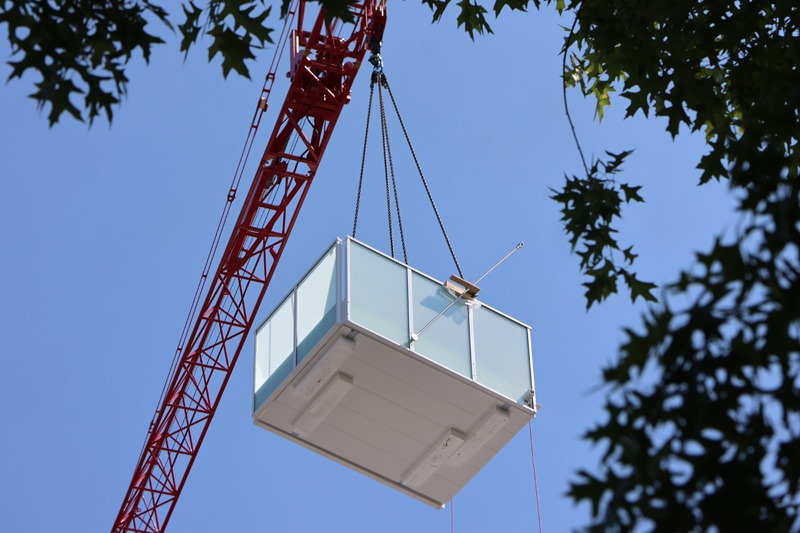
More construction components in Canada are built off-site than ever before. Figures show that adoption of modular construction in North America has more than tripled since 2015. But perhaps one overlooked aspect of the prefab revolution is balconies. Construction Canada spoke to Antonio Manchisi, vice president of construction at Sapphire Balconies, who says that prefab balconies not only save time and money but also improve the consistency and performance of the building envelope.
Construction Specifier (CS): Why should balconies be treated as installation events rather than treated in isolation?
Antonio Manchisi (AM): In the same way that the construction of a multi-storey building is treated like a choreographed dance, so too is balcony installation. When it comes to complex structures, treating each phase separately can be time-consuming and costly. When you approach each step with the mindset that one informs the next, you achieve a more efficient way to build a structure.
This applies to balconies in more ways than you would expect. The installation of balconies is a delicate dance that touches the project structure and envelope, involves crane logistics and trade sequencing, delivery cadence, and window inspections all at once. Connection points, tolerances, and embeds are co-ordinated early, reducing rework or on-site adjustments. Balconies are installed in rhythm with the progress of cladding and glazing, avoiding conflicts with access systems or swing stages.
A balcony itself is just a piece of the building. But when you plan it as a key step in how the project gets built, you get the time, cost, and performance gains that prefab can deliver.
From a practical perspective, this also means balcony installations are safer. The balcony interface is a convergence point of structure, envelope, thermal, acoustic, and sequencing elements. When installation is treated in isolation, it creates failure points. But if done right, there are multiple layers of time savings while ensuring proper installation. It turns balconies from a reactive site activity into a proactive, repeatable process.
CS: Please explain the layers of savings in the schedule and the thermal performance gains from integrating prefab balconies
AM: Balconies are not just products; they are installation events that must align with crane time, access, and facade progression.
Prefabricated balconies significantly reduce site congestion and schedule pressure, but this requires pre-planning of crane strategy and installation cadence. This means removing several sequential on-site activities. There is no on-site forming and pouring of cantilevered slabs; reduced need for temporary works, shoring, and curing periods; elimination of complex waterproofing tie-ins at slab edges; and less reliance on multiple follow-on trades working in the same zone.
Instead, balconies are manufactured simultaneously with the structure and facade, then installed as a single crane-led activity, typically in minutes rather than days per unit.
Modular systems are also fabricated in controlled environments, ensuring precision and reducing material waste. This has the added benefit of a thermal break installed at the factory. Beyond the thermal break itself, building envelope continuity (air barrier, vapour barrier, and insulation) is maintained at the facade line, rather than being interrupted by a cast-in slab. Factory integration of interfaces also reduces variability that leads to thermal weak points on-site. The simple act of creating separation allows a building to meet its energy code targets more easily while also avoiding the risk of condensation and mould at the balcony junction. All this translates into cost savings and durability.
The key takeaway here is that both benefits are interdependent: by relocating balcony construction offsite, you not only accelerate the program but also materially improve the consistency and performance of the building envelope.

CS: What are your insights on standardizing modular balcony installations?
AM: In 2025, Build Canada Homes really brought the conversation about standardized prefab to the forefront. It reignited the idea that Canada’s construction industry can leverage tried-and-true strategies. Many projects still reinvent connection strategies instead of leveraging repeatable, engineered systems that improve speed and reliability.
This does not mean identical balconies across a project but standardizing the critical technical interfaces. Connection brackets and embed layouts, load-transfer paths and fixing strategies, tolerance allowances between the structure and balcony units, and waterproofing and thermal interface details can be standardized.
The benefits are significant. Reusing proven details achieves design efficiency, reduces engineering time, and quickens approval cycles. Manufacturing consistency supports higher quality control and fewer production errors. Predictable installation allows crews to become familiar with a limited number of connection types, improving speed and reducing mistakes. Risk is also reduced since fewer one-off details mean fewer unforeseen issues during construction.
Importantly, standardization can still accommodate architectural variation—including size, finish, and railing systems—while maintaining a consistent structural and installation backbone.
CS: How do prefab balconies also improve reliability?
AM: One of the most compelling arguments for modular construction is its remarkable speed. Unlike traditional methods, modular construction allows off-site fabrication to occur concurrently with early site work. This parallel processing can shave weeks, or even months, off project timelines. Installations often require a single pick per balcony, resulting in faster completion, fewer delays, and less disruption to local communities. In a market grappling with labour shortages and supply chain volatility, this method offers more reliable delivery schedules.
However, the more valuable impact is on reliability and predictability. Factory quality control (QC) and quality assurance (QA) ensure consistent welds, finishes, and tolerances. Prefabricated units reduce dimensional variability compared to site-formed concrete. Pre-tested connection systems minimize on-site adjustments. Installation can be planned and repeated with a high degree of sequencing certainty.
When outcomes on a construction site are predictable, you can work on a tighter timeline, leave less wiggle room, and trust your installation dates will hold. That is the benefit of prefab balconies. In essence, they do not just make projects faster; they make outcomes more dependable. The latter is often the more valuable benefit for developers.
Sign up for our weekly newsletter
Construction Canada weekly newsletters give the latest AEC industry news for those who build, design, engineer, specify, renovate or operate in the built environment.
Read the Latest Issue

- CSC Hamilton-Niagara: Engineer’s View of Lime-Mortared Masonry with International Expert
- Message from the president | Message de la présidente: CSC First Quarter Update
- CSC Hamilton-Niagara Fun Night: Bowling at Parkway Social
- Oktoberfest 2026 – Vancouver Chapter CSC Trade Fair
- CSC Calgary October Meeting
Demo-Casts