Occupant thermal comfort: The blind spot of the building industry
Thermal comfort is defined as “that condition of mind which expresses satisfaction with the thermal environment,” as formalized in ASHRAE Standard 55, Thermal Environmental Conditions for Human Occupancy, and related international standards.1 Although inherently subjective, thermal comfort can be systematically evaluated using established analytical frameworks that account for environmental variables—including air temperature, mean radiant temperature (MRT), air velocity, and humidity—as well as personal factors such as clothing insulation and metabolic rate. These frameworks also address localized discomfort mechanisms, including radiant temperature asymmetry, vertical air temperature gradients, drafts, and floor/ceiling surface temperatures.2
The importance of interior surface temperatures is therefore not only a matter of thermal comfort theory but is also explicitly recognized in building codes. The National Building Code of Canada (NBC) states, “interior surface temperatures must be warm enough to avoid occupant discomfort due to excessive heat loss by radiation.” Despite this clear requirement, design practice and code compliance efforts have historically emphasized condensation control and minimum thermal resistance, with comparatively limited attention given to radiative heat transfer and its direct impact on occupant comfort. This disconnect highlights the need for design approaches that explicitly consider MRT and localized thermal discomfort, particularly in perimeter and highly glazed spaces.
Despite this well-established theoretical and regulatory foundation, building design practice continues to rely heavily on air temperature as a proxy for thermal comfort, largely because it is straightforward to model, measure, and control. Early comfort models, including Predicted Mean Vote (PMV) and Predicted Percentage of Dissatisfied (PPD) framework, provided a robust basis for whole-body heat balance but were frequently applied using simplified assumptions that underrepresented radiative effects and localized discomfort parameters.2 As a result, buildings may satisfy temperature-based compliance criteria while still exposing occupants to discomfort driven by enclosure surface temperatures and spatial asymmetry.
Practitioner-oriented research has long highlighted this gap between theory and application. Mora and Bean observed that thermal comfort analysis is rarely integrated into early design stages, with most projects prioritizing system sizing and code compliance over occupant experience.3 Subsequent work further emphasized that thermal comfort is often treated as a post-occupancy concern, even though enclosure design decisions made early in the process strongly influence occupant perception.4
Among the environmental variables governing comfort, MRT and short-wave solar radiation have been shown to exert a dominant influence, particularly in perimeter spaces and high-performance buildings with large glazing areas. Arens, Hoyt, and colleagues demonstrated that direct solar radiation can materially alter occupant thermal sensation even when operative temperature and PMV values indicate compliance.5 This research directly informed the development of simplified solar comfort models and contributed to later revisions of ASHRAE Standard 55.1
In parallel with the development of comfort theory, ASHRAE-sponsored research has advanced the computational representation of thermal comfort. Research Project 1383-RP introduced methodologies for calculating occupant-specific MRT, radiant temperature asymmetry, and spatial comfort distributions by explicitly modelling enclosure surface temperatures and view factors.6 These capabilities were further expanded under 1766-RP, which integrated room-level load calculations with comfort-related outputs suitable for design-stage analysis.7 Together, these efforts demonstrated that detailed comfort evaluation is technically feasible within modern simulation environments.
Air movement and distribution effects introduce additional complexity. Int-Hout highlighted that air velocity, stratification, and diffuser performance are among the most difficult comfort parameters to predict at the design stage, yet they significantly influence occupant satisfaction and compliance with ASHRAE Standard 55.8 When these factors are not explicitly considered, comfort deficiencies are often addressed reactively through operational adjustments or occupant-controlled devices.
Field studies have reinforced the consequences of these limitations. The ASHRAE RP-821 investigation documented persistent discrepancies between predicted comfort conditions and occupant responses in mechanically ventilated office buildings, particularly in cold climates where radiant effects and air movement preferences were pronounced.9 These findings underscore the limitations of relying on air temperature–based metrics alone and highlight the need for a more holistic approach to comfort evaluation.
Knowledge gaps and objectives
Based on the reviewed literature and observed industry practice, several gaps remain:
- Thermal comfort is frequently reduced to air temperature targets, with limited evaluation of MRT, solar exposure, and radiant asymmetry during design1,5
- Comfort analysis tools exist but are not well integrated into standard energy modelling workflows, limiting their practical adoption6,7
- Architectural decisions—such as glazing ratios, shading geometry, enclosure performance, and space proportions—are rarely evaluated through a comfort-first lens3,4
- There is limited guidance for practitioners on how to translate comfort metrics into actionable architectural and mechanical design decisions8,9
The objective of this paper is to demonstrate how thermal comfort analysis can be systematically integrated into architectural and energy modelling workflows, allowing designers to better align predicted performance with lived occupant experience—without relying solely on post-occupancy correction or energy-intensive mechanical solutions.
Analytical framework for evaluating thermal comfort
Overview of thermal comfort metrics
PMV and PPD are the most widely used whole-body thermal comfort indices in building design practice. Developed by Fanger, the PMV index predicts the average thermal sensation of a large group of occupants on a seven-point scale ranging from cold (–3) to hot (+3), based on a steady-state heat balance between the human body and its environment.2 PPD is derived directly from PMV and represents the expected percentage of occupants dissatisfied with the thermal conditions, acknowledging that even under ideal conditions a minimum level of dissatisfaction persists. Under this framework, acceptable thermal comfort is typically defined by a PMV range of approximately –0.5 to +0.5, corresponding to a PPD of 10 per cent or less.
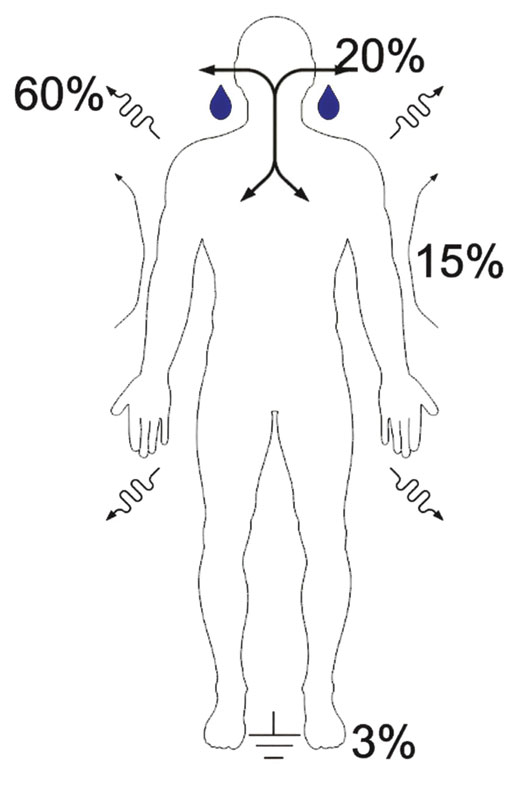
Key environmental variables influencing comfort include air temperature, MRT, air velocity, and humidity, as well as personal factors such as clothing insulation and metabolic rate.2 Among these variables, MRT plays a particularly critical role in spaces where enclosure surface temperatures differ substantially from air temperature. Figure 1 illustrates the dominant heat transfer mechanisms from the human body, showing that radiative heat exchange can account for up to approximately 60 per cent of total heat transfer between the human body and surrounding surfaces under typical indoor conditions. This highlights the strong influence of enclosure surface temperatures on perceived thermal comfort, particularly in high-performance or poorly balanced enclosures.
Robert Bean’s work synthesizes decades of physiological research and building science literature, emphasizing that humans experience thermal comfort primarily through radiant exchange rather than air temperature alone.10 His analysis demonstrates air temperature (thermostat) is an incomplete proxy for comfort and that occupants are highly sensitive to the thermal characteristics of surrounding surfaces. Bean further notes that small deviations in surface temperatures—such as cold glazing, uninsulated slabs, or overheated ceilings—can dominate occupant sensation even when air temperature is well controlled. This reinforces the importance of managing mean radiant temperature through envelope design, insulation continuity, thermal bridge mitigation, and the use of radiant heating and cooling systems to achieve true occupant comfort.
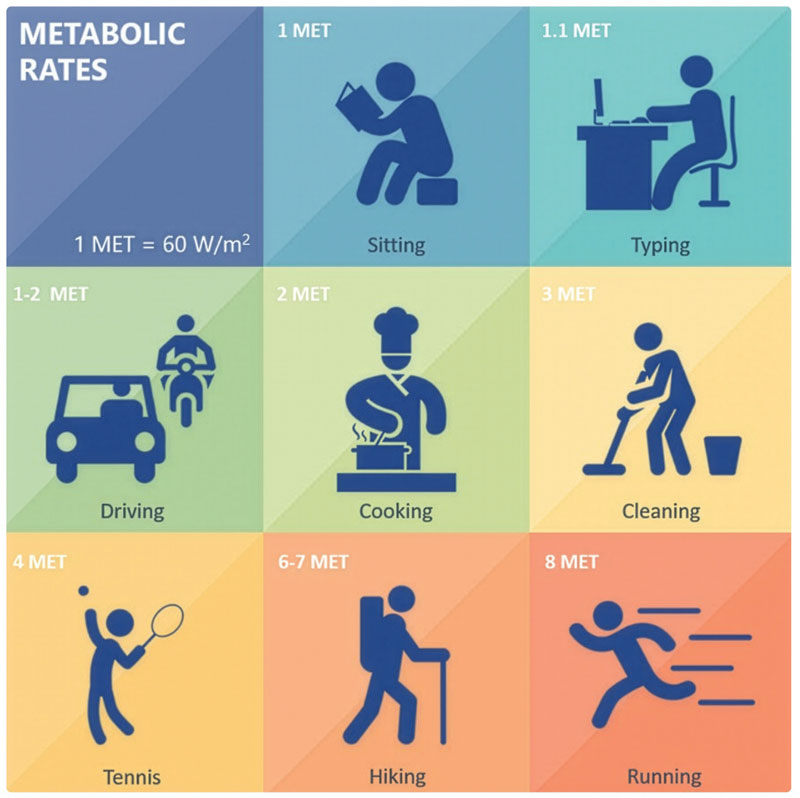
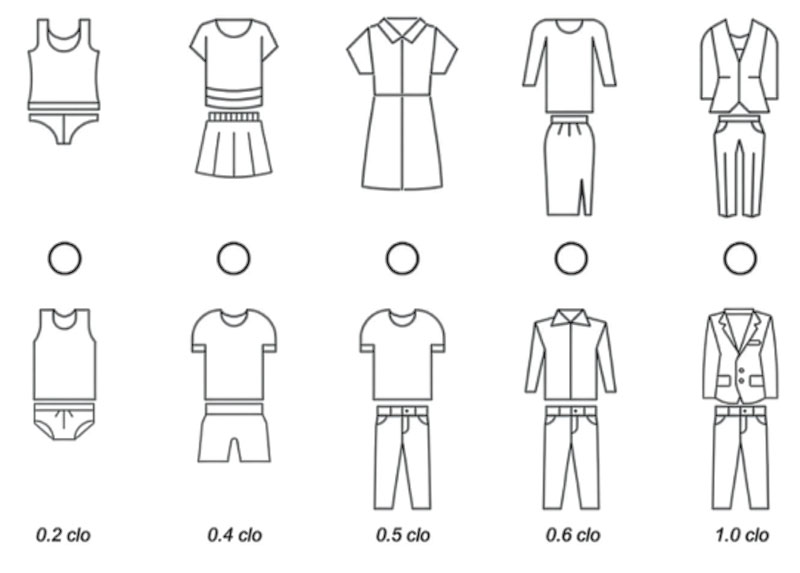
Figure 2 illustrates typical ranges of metabolic activity (MET) and clothing insulation levels (clo) commonly encountered in residential and commercial indoor environments. MET represents the rate of heat generation within the human body due to activity, where one MET corresponds to approximately 58–60 W/m² (18.4–19.0 Btu/h·ft²) of body surface area, representative of a seated, resting individual. As activity levels increase, internal heat production rises, directly influencing thermal sensation. Clo quantifies the thermal resistance provided by clothing ensembles, where one clo corresponds to a thermal resistance of approximately 0.155 m²·K/W (0.88 ft²·h·F/Btu). Together, MET and clo govern the balance of heat exchange between the human body and its surrounding environment and must be considered alongside environmental parameters when evaluating thermal comfort at both global and local scales. ASHRAE Standard 55 evaluates thermal comfort for occupants with metabolic rates up to 2.0 met and clothing insulation levels up to 1.5 clo, corresponding to typical indoor activities and clothing conditions.
Table 1:
|
Thermal comfort factors |
|
| General environmental factors | Localized factors |
| Dry-bulb temperature | Vertical air temperature |
| Mean radiant temperature | Radiant temperature asymmetry |
| Humidity | Ceiling and floor temperatures |
| Air speed | Drafts and ankle draft |
|
Personal factors |
|
| Metabolic rate | |
Localized discomfort mechanisms—such as radiant temperature asymmetry, vertical air temperature differences, drafts, and floor surface temperatures—are explicitly addressed in ASHRAE Standard 55 due to their disproportionate influence on occupant perception.1 Local discomfort factors are of particular importance for lightly clothed persons (with clothing insulation between 0.5 and 0.7 clo) engaged in near-sedentary physical activity (with metabolic rates between 1.0 and 1.3 met). Table 1 summarizes the key thermal comfort factors to consider when evaluating occupant comfort at both global and local scales.
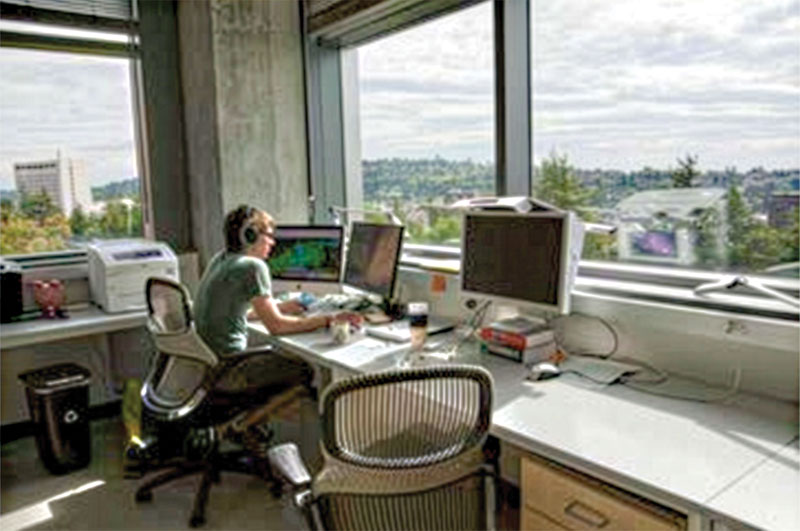
Research has consistently shown that occupants may experience discomfort driven by radiative and solar effects even when zone-level air temperature and PMV criteria are satisfied.5 As a result, a comfort-focused analysis must extend beyond bulk air conditions to account for spatial variability, enclosure performance, and occupant proximity to radiant surfaces. ASHRAE Standard 55-2023, Table I-1, outlines acceptable limits for local thermal discomfort, including five per cent PPD for radiant-temperature asymmetry and vertical air-temperature differences, 10 per cent for warm or cold floor surfaces, and 20 per cent for draft.1 Table 1 summarizes the key thermal comfort factors that should be considered when evaluating occupant comfort at both global and local scales. Figure 3 illustrates the impact of short-wave solar radiation on human thermal comfort, demonstrating how direct solar exposure can dominate occupant thermal sensation despite otherwise acceptable indoor air temperatures. This example reinforces the importance of accounting for radiant heat transfer and localized environmental conditions when assessing comfort, particularly in perimeter zones with high glazing ratios or limited solar control.
Localized thermal comfort evaluation
To evaluate localized thermal comfort parameters, this study employed established, practitioner-oriented thermal comfort tools aligned with the analytical framework of ASHRAE Standard 55.
The Payette localized thermal comfort tool was used to assess draft risk and radiant temperature asymmetry,12 with particular focus on occupant locations adjacent to facades and glazing. These localized discomfort mechanisms are explicitly addressed in ASHRAE Standard 55 and are known to be strongly influenced by enclosure surface temperatures, glazing thermal performance, and occupant proximity to exterior assemblies.
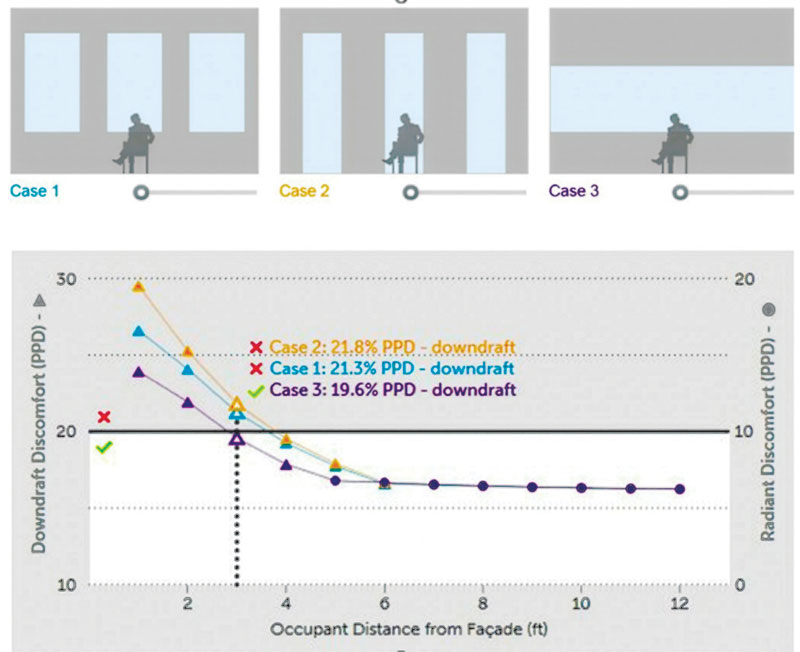
Figure 4 presents the analytical approach adopted by Payette to quantify localized discomfort near glazed façades under winter conditions.13 The figure demonstrates the relationship between occupant distance from the facade and predicted downdraft discomfort (PPD) for different glazing configurations, highlighting how window geometry and thermal performance can result in elevated discomfort levels even when zone-level comfort criteria are met. The results underscore that localized discomfort—particularly cold downdrafts and radiant asymmetry—can dominate occupant experience within the first few feet of the facade.
The use of simplified analytical tools allows these localized effects to be evaluated without reliance on full computational fluid dynamics (CFD) modelling, which is often impractical during early design phases. Within this framework, localized comfort evaluation serves as a critical bridge between whole-body comfort metrics and architectural decision-making. By isolating the influence of glazing characteristics, enclosure performance, and occupant location, these tools enable a direct linkage between facade design parameters and predicted comfort outcomes, establishing the analytical basis for the results presented in the following section.
Integration with whole-building energy modelling
While localized comfort tools provide valuable insight into occupant-level conditions, they must be contextualized within the broader thermal behaviour of the building. To this end, whole-building energy modelling was performed using IES Virtual Environment (IES VE) to evaluate the interaction between envelope design, solar gains, and indoor thermal conditions.
IES VE enables dynamic simulation of building thermal performance, including zone-level air temperatures, surface temperatures, solar heat gains, and shading effects. Although conventional energy models are primarily used to assess energy consumption and compliance, prior research has demonstrated that model outputs—particularly surface temperatures and solar radiation data—can inform comfort-related analyses when appropriately interpreted.6,7
In this study, IES VE was used to conduct a parametric envelope analysis focusing on variations in window-to-wall ratio (WWR), glazing distribution, and solar shading. These parameters were selected for their strong influence on both energy performance and occupant comfort, particularly through their effects on MRT and short-wave solar radiation. By isolating envelope-driven effects, the analysis avoids conflating comfort outcomes with mechanical system performance, consistent with prior recommendations in the literature.3,4
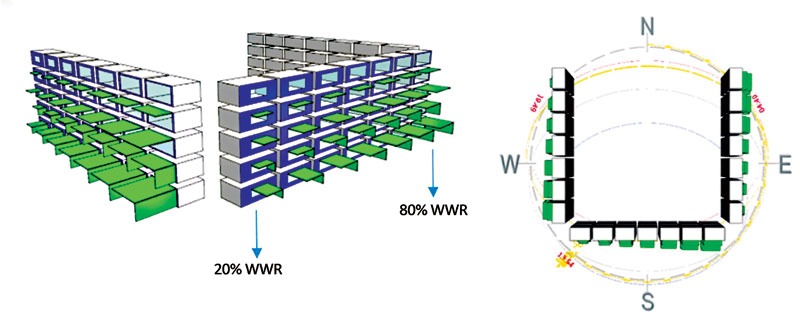
Figure 5 illustrates the parametric facade study used to evaluate the influence of WWR and external shading depth on building performance. WWR ranging from 20 to 80 per cent were evaluated, with each vertical column representing a discrete WWR configuration. For each WWR case, a series of horizontal external shading devices was modelled with increasing shading projection factor (PF), defined as the ratio of shading projection depth to window height. Shading conditions range from PF = 0 (no external shading) to PF=1.0, representing a shading projection equal to the window height.
This parametric arrangement enables a systematic assessment of the combined effects of glazing area and solar shading on solar gains, mean radiant temperature, and occupant thermal comfort. By isolating WWR and shading depth as independent variables, the study framework supports comparative analysis of facade design strategies and their implications for both energy performance and localized thermal comfort, particularly in perimeter zones exposed to solar radiation.
Envelope-driven comfort analysis approach
The analytical approach adopted in this study emphasizes the role of architectural and enclosure decisions in shaping thermal comfort outcomes. Rather than treating comfort as a downstream validation step, the methodology evaluates how envelope design choices establish the boundary conditions within which mechanical systems must operate.
Previous ASHRAE research has shown that accurate representation of enclosure surface temperatures and view factors is essential for meaningful comfort assessment.6 Field studies have further demonstrated that discrepancies between predicted and perceived comfort often arise from enclosure-driven effects that are not captured by air temperature–based metrics alone.9 By combining localized comfort evaluation with whole-building energy modelling, the methodology establishes a consistent framework for assessing how changes in WWR and solar exposure influence occupant experience.
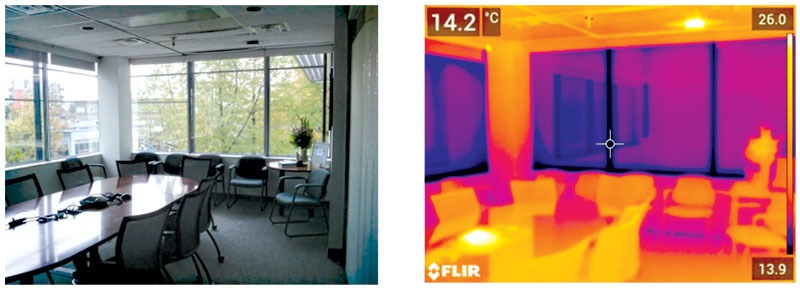
Figure 6 illustrates this enclosure-driven comfort framework by comparing visual and infrared thermal imagery of a perimeter space. This thermogram was taken when the outside temperature was 9 C (48 F) and the thermostat showed an interior air temperature of 22 C (72 F). The thermal image reveals pronounced surface-temperature variations associated with glazing and exterior assemblies. These non-uniform radiant conditions directly affect mean radiant temperature and localized thermal comfort, demonstrating how enclosure design decisions can dominate occupant sensation independently of zone-level air temperature.
This approach does not directly optimize comfort in this section; rather, it defines the analytical basis for the results presented in the following section. The intent is to demonstrate how existing tools and workflows can be applied in a complementary manner to reveal comfort implications that are often overlooked in conventional design practice.
Results and discussion
This section presents the results of the thermal comfort analyses. The discussion first focuses on localized thermal comfort conditions near the building facade, as investigated by the Payette tool, where enclosure-driven effects are most pronounced. The section then presents the outcomes of the dynamic envelope simulations conducted in IES VE, examining the influence of facade design parameters on indoor thermal performance.
Thermal comfort study: Local factors—downdraft and radiant asymmetry
Four window-related parameters were identified as the primary drivers of localized thermal comfort conditions in the immediate vicinity of the facade. These parameters influence occupant comfort through two dominant mechanisms: (1) convective downdraft, caused by buoyancy-driven airflow as warm indoor air comes into contact with colder glazing surfaces, and (2) radiant thermal asymmetry, resulting from increased view factors between occupants and the window surface. For the analyses presented in this section, the WWR was held constant at 50 per cent across all cases. The opaque wall assembly was assumed to have a thermal resistance of RSI–2.64 (R–15 ft²·h·F/Btu). Boundary conditions included an outdoor air temperature of -12 C (10 F), an indoor air temperature of 22 C (72 F), and an indoor relative humidity of 50 per cent.
Window height
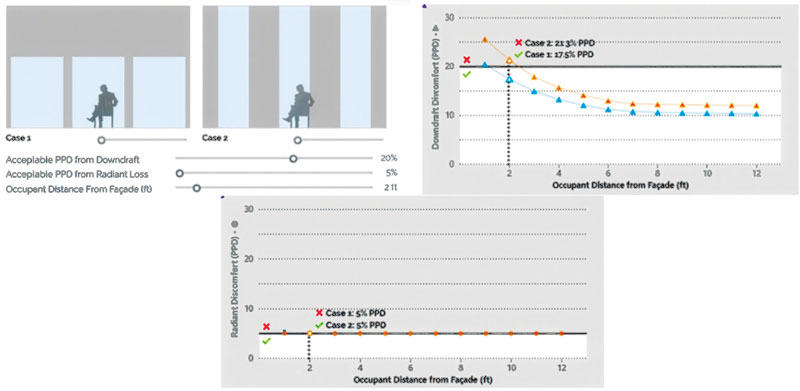
Increasing window height was found to influence localized thermal comfort primarily through enhanced downdraft effects near the facade. As shown in Figure 7, the two window-height configurations exhibited similar levels of predicted radiant discomfort, reflecting comparable occupant view factors to the glazing in both cases. Consequently, differences in the predicted PPD near the facade are predominantly driven by convective mechanisms rather than by radiant asymmetry. Taller window configurations result in greater localized discomfort near the facade, with PPD decreasing as the occupant’s distance from the window increases. This finding is particularly relevant for architects specifying floor-to-ceiling glazing systems, as the results indicate that increased window height can exacerbate near-facade downdraft-driven discomfort even when radiant conditions remain unchanged. As illustrated in Figure 7, the influence of window height diminishes with increasing setback from the facade, indicating that these effects are most pronounced within the immediate perimeter zone.
Window sill height
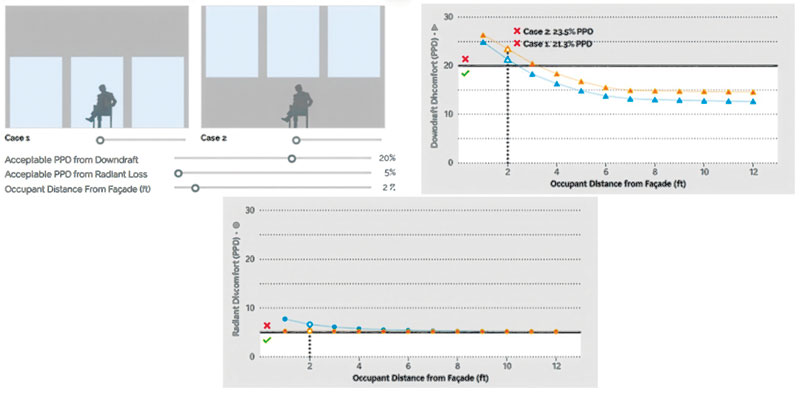
The window sill height was found to influence localized thermal comfort through competing convective and radiative mechanisms. As illustrated in Figure 8, increasing sill height reduces radiant discomfort by lowering the occupant’s view factor to the glazing, thereby decreasing radiant heat exchange between the occupant and the cold window surface. This effect is reflected in the relatively small differences in predicted radiant discomfort between cases, particularly beyond the immediate facade zone.
Conversely, the results indicate that higher sill configurations can exacerbate convective downdraft effects near the facade. By concentrating colder glazing surfaces at higher elevations, buoyancy-driven airflow intensifies as cooled air descends along the window surface and enters the occupied zone. As shown in Figure 8, this results in increased predicted discomfort from downdrafts near the facade, despite the reduction in radiant exposure. The combined results highlight that adjustments to sill height can shift the dominant source of localized discomfort rather than eliminate it, underscoring the need to consider both convective and radiative effects when evaluating facade geometry.
Window thermal transmittance (U value)
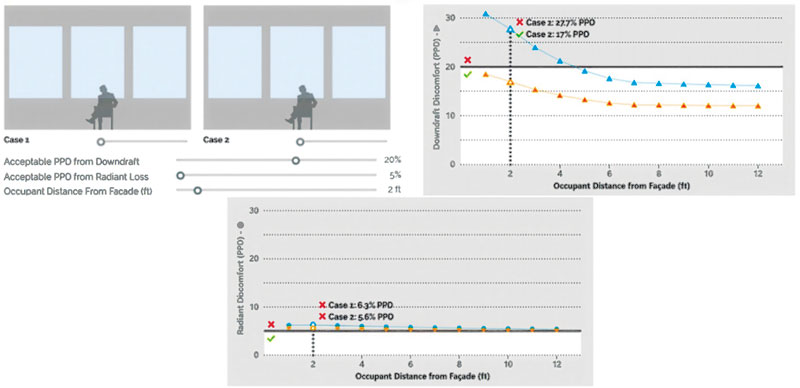
Variations in window U-value were found to influence localized thermal comfort predominantly through changes in downdraft-related discomfort. As shown in Figure 9, the case with improved glazing thermal performance (Uip–0.18 versus Uip–0.35 Btu/ft²·h·°F) exhibits a substantial reduction in predicted downdraft discomfort in the immediate vicinity of the facade. At an occupant distance of 0.61 m (2 ft), the PPD due to downdraft decreases markedly between the two cases, with the difference gradually diminishing as the occupant distance from the facade increases. This behaviour reflects higher interior glazing surface temperatures associated with lower U-values, which weaken buoyancy-driven downward airflow along the window surface.
Although the predicted radiant asymmetry results shown in Figure 9 for the 50 per cent WWR cases differ only marginally between glazing configurations, additional analyses indicate that the influence of glazing U-value on radiant discomfort becomes more pronounced at higher WWRs. At increased WWRs, larger exposed glazing areas increase occupant view factors to the window surface, amplifying the sensitivity of radiant asymmetry to glazing thermal performance. Consequently, while downdraft effects dominate localized discomfort at moderate WWRs, radiant asymmetry becomes more significant as glazing area increases.
Interior side low-e coating
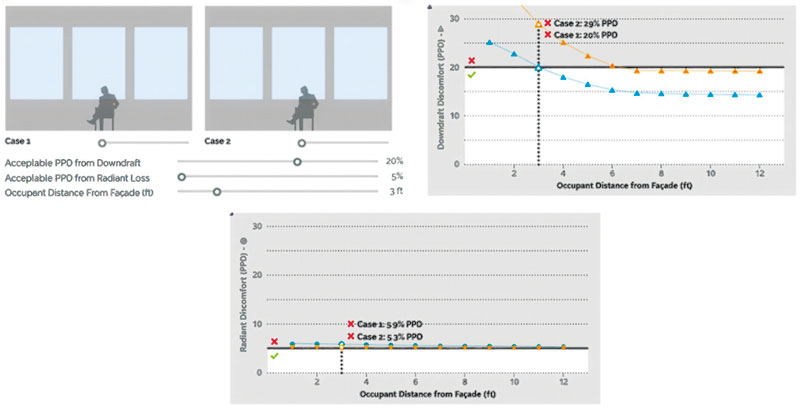
The presence of an interior low-emissivity (low-e) coating was found to influence localized thermal comfort through opposing convective and radiative mechanisms. As shown in Figure 10, the inclusion of an interior low-e coating results in increased predicted downdraft-related discomfort in the immediate vicinity of the facade. This behaviour is attributed to the reduction in interior glass surface temperature associated with the low-e coating, which enhances buoyancy-driven downward airflow along the glazing surface. The impact of this increased downdraft is most pronounced within the near-facade zone and diminishes with increasing occupant distance from the window.
In contrast, the interior low-e coating produces a modest but consistent reduction in radiant discomfort. As illustrated in Figure 10, predicted radiant asymmetry values are slightly lower for the low-e case across all occupant distances. This improvement is attributed to the reduced emissivity of the interior glass surface, which limits long-wave radiant heat exchange between the occupant and the glazing. Although the reduction in radiant discomfort is smaller in magnitude than the increase in downdraft-related discomfort, the results highlight the competing nature of convective and radiative effects introduced by interior low-e coatings and underscore the importance of evaluating both mechanisms when assessing localized thermal comfort near facades.
Thermal comfort study: Envelope effects—WWR and exterior shades
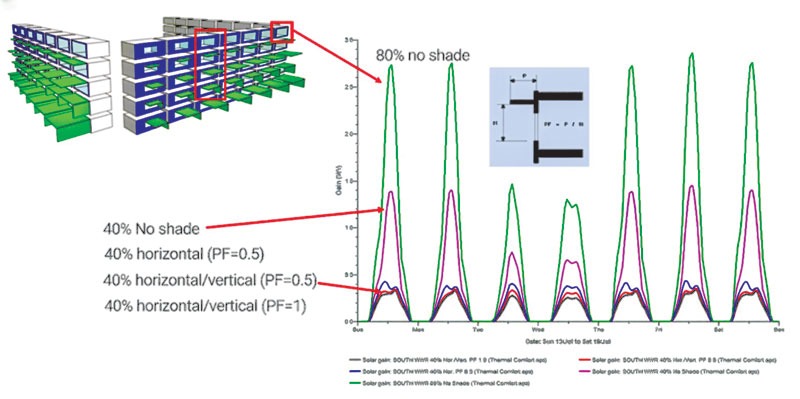
Before examining the impact of WWR and exterior shading on MRT, it is important first to assess how these parameters influence solar heat gains and resulting cooling demand. Figure 11 evaluates the effect of facade configuration on zone-level thermal conditions. Dynamic simulations were conducted to quantify incident solar gains under varying WWRs and exterior shading geometries.
The results further demonstrate the moderating effect of exterior shading devices. For the 40 per cent WWR configuration, introducing horizontal shading (projection factor, PF=0.5) results in a marked reduction in peak solar gain relative to the unshaded case. The combined horizontal and vertical shading configuration provides additional attenuation, particularly during periods of high solar altitude. The case with increased projection factor (PF=1) yields the greatest reduction in peak gains, indicating the sensitivity of solar exposure to shading geometry. These findings illustrate the strong dependence of envelope-driven heat gains on both glazing ratio and shading design. While WWR primarily governs the magnitude of solar exposure, exterior shading effectively modulates peak intensities and the temporal distribution of gains, thereby influencing MRT and overall thermal comfort conditions within the perimeter zone.
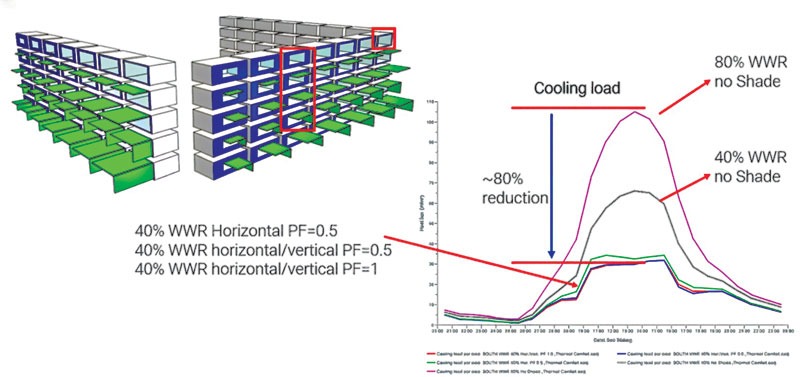
To further evaluate the implications of facade configuration on building performance, dynamic simulations were conducted to assess perimeter-zone cooling loads under varying WWR and exterior shading configurations. As shown in Figure 12, increasing WWR substantially amplifies peak cooling demand. The unshaded 80 per cent WWR case exhibits significantly higher peak cooling loads compared to the 40 per cent WWR configuration, reflecting the strong dependence of cooling demand on solar heat gains through glazing.
The introduction of exterior shading devices produces a pronounced reduction in peak cooling load. For the 40 per cent WWR cases, horizontal shading (PF=0.5) reduces peak cooling demand relative to the unshaded configuration, while the combined horizontal and vertical shading arrangements further attenuate peak loads. The case with PF=1 demonstrates the greatest reduction in peak cooling demand, indicating the sensitivity of cooling performance to shading depth and geometry.
As illustrated in Figure 12, the shaded 40 per cent WWR configurations achieve an approximate 80 per cent reduction in peak cooling load relative to the unshaded 80 per cent WWR case. These results highlight the strong coupling between facade design, solar exposure, and mechanical system demand, reinforcing the importance of integrating glazing ratio and shading geometry considerations at early design stages.
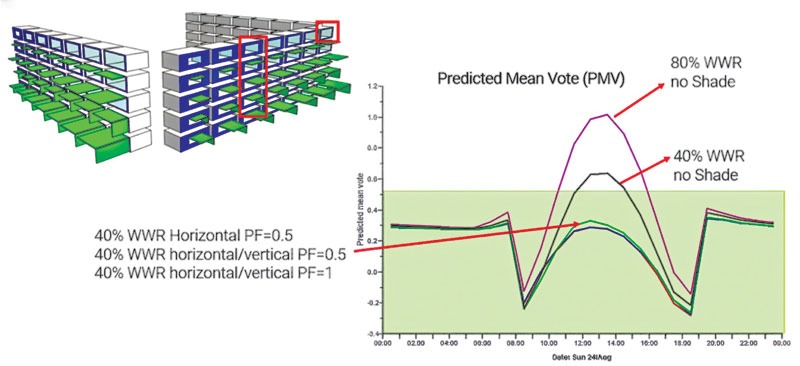
To assess how variations in glazing ratio and exterior shading affect whole-body thermal comfort, PMV values were calculated for the same facade configurations discussed previously. As shown in Figure 13, increases in WWR substantially elevate peak PMV values during periods of high solar exposure. The 80 per cent WWR unshaded case exhibits the highest midday PMV, approaching or exceeding the upper comfort threshold. In contrast, the 40 per cent WWR configuration demonstrates more moderate values under identical boundary conditions.
The introduction of exterior shading devices significantly moderates peak PMV. For the 40 per cent WWR cases, horizontal shading (projection factor, PF=0.5) reduces peak thermal sensation relative to the unshaded case, while the combined horizontal and vertical shading configurations further attenuate peak PMV values. The configuration with increased projection factor (PF=1) produces the lowest peak PMV among the cases examined.
These results demonstrate that facade design directly influences occupant thermal sensation by modulating solar gains and altering MRT. Higher glazing ratios amplify solar-driven increases in MRT, leading to elevated PMV during peak hours, while appropriately designed exterior shading effectively maintains PMV within the acceptable comfort range for a greater portion of the day.
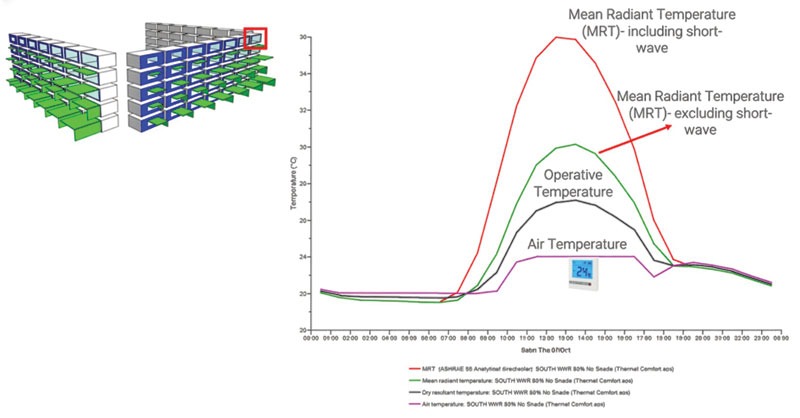
Figure 14 illustrates the influence of short-wave solar radiation on MRT and resulting operative temperature under the unshaded 80 per cent WWR condition. The comparison highlights the difference between MRT calculated in accordance with ASHRAE 55-2023, which explicitly accounts for short-wave solar radiation incident on the occupant, and MRT calculated excluding short-wave effects, consistent with earlier methodologies such as those commonly aligned with ASHRAE 55-2013.
As shown in Figure 14, the inclusion of short-wave radiation results in a substantial increase in peak MRT during periods of direct solar exposure. While the zone thermostat maintains an air temperature setpoint of 24 C (75 F), the short-wave-adjusted MRT rises significantly above both air temperature and long-wave-only MRT. Consequently, operative temperature—defined as the combined effect of air temperature and mean radiant temperature—also increases markedly during peak solar hours.
The results demonstrate that reliance on air temperature alone, or on MRT calculations excluding short-wave solar effects, can substantially underestimate occupant thermal sensation in perimeter zones with high solar exposure. Even with a controlled air temperature of 24 C (75 F), operative temperatures exceed comfort thresholds when short-wave radiation is considered. This finding underscores the importance of incorporating direct solar effects in comfort assessments, particularly in high-glazing configurations.
Conclusion
This paper examined the influence of facade design parameters on thermal comfort in perimeter zones. The following conclusions can be drawn:
- Window geometry strongly affects localized discomfort. Increasing glazing height and area intensifies the downdraft near the facade, while altering sill height alters the balance between convective and radiative effects.
- Glazing thermal performance primarily influences comfort through downdraft mechanisms at moderate WWRs, with radiant effects becoming more significant at higher glazing ratios.
- Interior low-e coatings introduce competing effects: reduced emissivity improves radiant asymmetry, while lower interior glass temperatures may increase downdraft discomfort.
- Increasing WWR substantially elevates solar gains and peak cooling loads. Exterior shading effectively reduces both solar exposure and cooling demand.
- Facade configuration directly impacts PMV through changes in MRT, with high-glazing unshaded cases producing elevated peak thermal sensation.
- Inclusion of short-wave solar radiation in MRT calculations (ASHRAE 55-2023) significantly increases peak operative temperatures, indicating that comfort assessments excluding short-wave effects may underestimate thermal stress in highly glazed zones.
Overall, the results demonstrate that enclosure design decisions establish the thermal boundary conditions governing occupant comfort and mechanical system demand. Early-stage evaluation of facade parameters is therefore critical for achieving both energy and comfort objectives.
Notes
Authors

Dr. Mohammad Fakoor is technical lead of the building performance team at RJC Engineers. He specializes in energy modelling, airtightness testing, and life-cycle carbon analysis, contributing to residential, commercial, and industrial projects. A published author and lecturer, he advances building performance through research and practice.

Parvin Asadi, P.Eng., is a building performance project engineer at RJC Engineers, specializing in energy modelling and performance analysis for new and retrofit projects. She focuses on integrating mechanical systems and building enclosures to improve efficiency across residential, commercial, and institutional sectors.

Danielle Arciaga, E.I.T., is a building performance engineer at RJC Engineers specializing in life-cycle carbon assessments. She works on new and retrofit projects, with experience in energy modelling and airtightness testing, and received the 2023 Andy Kesteloo Award for a decarbonization study at Simon Fraser University.
Sign up for our weekly newsletter
Construction Canada weekly newsletters give the latest AEC industry news for those who build, design, engineer, specify, renovate or operate in the built environment.
Products & Services
Read the Latest Issue
Demo-Casts