
Expert interview: When insulation makes or breaks performance
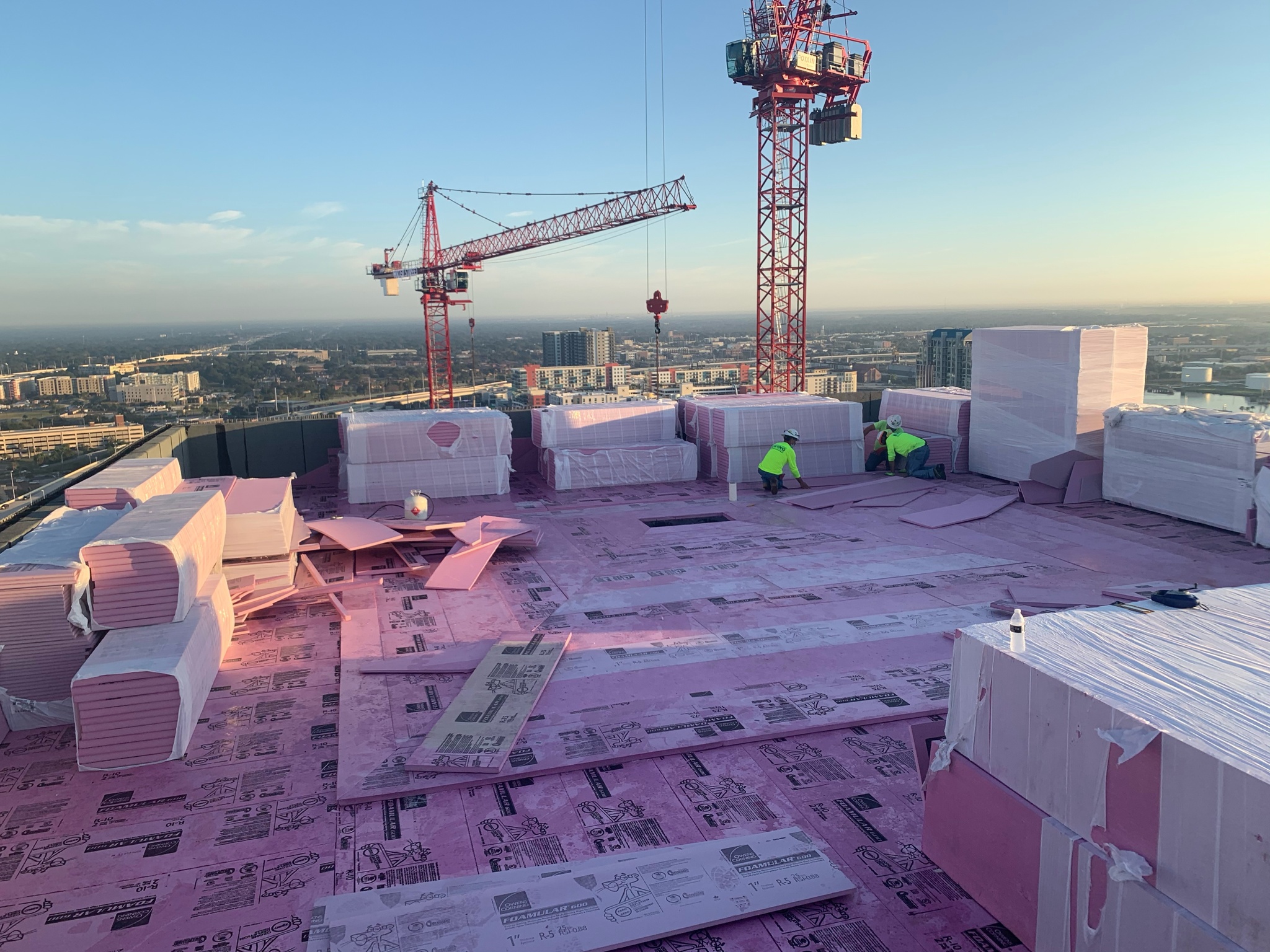
The below-grade and roof areas of the commercial enclosure present particularly demanding requirements for insulating materials. If the nuances of these spaces are not considered during the specification process, problems ranging from structural damage to stormwater runoff issues can result. The challenges become even more complex when insulating areas that deliver functional space, such as vegetative roofs or plaza decks.
Construction Canada spoke to Tiffany Coppock, AIA, NARB, CSI, CDT, RCI, LEED, commercial building specialist at Owens Corning, about the upside and downside considerations for insulating above- and below-grade spaces.
How do differences in the manufacturing process of rigid foam insulation—such as blowing agents or cell structure—translate into long-term performance differences once the material is installed?
When comparing the three most common rigid foam boards, polyiso, expanded polystyrene (EPS), and extruded polystyrene (XPS), there are both similarities and important differences. Polyiso is made by reacting a polyol, isocyanate, and blowing agent to create foam, which always requires facers. These facers are critical to performance, providing vapour control, reinforcement, or reflectivity, but any damage to them reduces effectiveness. Polyiso’s irregular cell structure can also create pathways for moisture, further increasing reliance on the facer.
EPS is formed by fusing polystyrene beads in a mould. This creates voids between beads where air and water can move, allowing the insulation to absorb moisture, especially in persistently wet conditions, which reduces thermal performance and increases the risk of weight and freeze damage. EPS advocates note it doesn’t lose blowing agents over time, but its R-value starts lower (around R-4) and remains below that of XPS.
XPS is made by combining polystyrene with a blowing agent and extruding it into boards. While limited in thickness and sensitive to high temperatures, the process creates a uniform cell structure that effectively traps gas, delivering higher R-values and strong compressive strength. This makes XPS suitable for demanding applications, such as below-grade foundations and low-slope roofs, even under heavy traffic loads.
What are the most common mistakes made in material selection or installation, and how can they be avoided?
Many common mistakes stem from a misunderstanding of the application. In cold climates, polyiso may appear to offer the highest R-value, but many blowing agents begin to condense around 4.4 C (40 F), significantly reducing performance—often when insulation is needed most. A roof designed to reach R-42 with 178 mm (7 in.) of polyiso may achieve that in summer, but winter performance can drop close to half. In those conditions, XPS (around R-5 per in.) is often a better choice, as its R-value increases as temperatures drop.
Fire performance is another frequent source of confusion. NFPA 285 is often misunderstood in commercial buildings (any building governed by the International Building Code (IBC)). Foam insulation is not the only trigger—other combustible components like cladding, air barriers, and structural elements can also require testing. Height-based exemptions are limited, and NFPA 285 appears in multiple sections of the IBC, all of which must be reviewed.
Bottom line: mineral wool or brick cladding alone doesn’t automatically resolve NFPA 285 requirements. Residential projects following the International Residential Code (IRC) are exempt, but residential occupancies governed by the IBC may still need to comply.
What are the specific moisture management challenges for below-grade insulation, and how can they be mitigated?
For below-grade insulation, drainage is critical regardless of material. Even water-resistant insulation can absorb moisture under constant hydrostatic pressure if a foundation doesn’t drain properly. Long-term studies show XPS absorbs less moisture than other foams, but it also has limits. Foundations must drain—using drain boards, grooved insulation, proper grading (minimum 2 per cent slope), and directing gutters away from the building.
While XPS resists bulk water, long-term research shows its primary moisture uptake mechanism is vapour diffusion, especially when vapour is trapped by a closed assembly (such as a vapour retarder adjacent to the insulation). EPS faces the same vapour issue, plus additional water movement between beads, making it unsuitable for high-moisture applications like protected membrane roof assembly (PMRA) roofs.
Sign up for our weekly newsletter
Construction Canada weekly newsletters give the latest AEC industry news for those who build, design, engineer, specify, renovate or operate in the built environment.
Read the Latest Issue


- Reducing a Billion Dollar Problem in Construction Through Correct Moisture Testing of Concrete
- Reducing a billion dollar problem in construction through correct moisture testing of concrete
- Message from the president | Message de la présidente : The role of product information in specification
- 💻 Author-led sessions on new CCDC documents
- PCD and CCA In-Person Courses