Data centre access solutions: Tips for specifying insulated sectional and rolling doors

As demand for digital infrastructure surges across Canada, data centre construction is accelerating at an unprecedented pace. For architects, designers, and engineers, these facilities present unique challenges, particularly specifying the all-important building envelope, which often includes insulated overhead sectional and rolling doors. Not only must these doors provide durable, secure access to the building, but they must also protect the tightly controlled interior climate. Successfully specifying doors that meet these high standards requires a top-to-bottom analysis of system components and their latest advancements.
How indoor climate impacts door performance
Canada’s abundant land, access to hydroelectric power, and cooler climate have made it an attractive location for large-scale data centres, but not without challenges. In major cities such as Montreal and Toronto, and in provinces such as Alberta, where the country’s IT load is concentrated, the weather varies dramatically from season to season and even day to day. This variability requires special consideration in the design and construction of the components that maintain a stable indoor climate. With facilities spanning up to hundreds of thousands of square feet, multi-building campuses, and energy-efficient operations, efficiency is always a priority. However, the drivers of efficiency differ from those of other large commercial buildings, such as warehouses or distribution centres.
Operating with minimal on-site personnel, data centres are optimized for equipment performance rather than human comfort, and their success depends on precise control of indoor climate conditions. These sensitive conditions demand superior performance from the entire building envelope, particularly the overhead sectional and rolling doors used in the data centre’s largest openings. The three most important factors defining these sensitive indoor conditions and informing door specifications are as follows.
Temperature
Data centres typically operate within a range of approximately 18 to 27 C (64 to 81 F), with many facilities targeting a narrower range to maintain uniform conditions across server racks. Holding temperatures within this range helps prevent equipment from overheating, throttling, or shutting down, and it limits thermal stress caused by rapid or uneven temperature changes. While cold weather is often beneficial for data centre operations, extremely cold outdoor temperatures can be troublesome if not properly managed. Consistent temperatures support predictable HVAC performance and the reliability and service life of IT equipment, making temperature stability just as important as the setpoint.
What this means for doors
Overhead sectional and rolling steel doors must limit thermal transfer through large openings by using high-quality insulation and engineered thermal breaks to avoid localized thermal losses or gains.
Humidity
Relative humidity (RH) in data centres is often maintained in a moderate range from 40 to 60 per cent. Keeping humidity within this band reduces the risk of electrostatic discharge in overly dry conditions. It limits the potential for moisture accumulation on equipment and building surfaces when humidity is too high. This balance is especially critical near exterior walls and door openings, where cold surfaces can trigger condensation if humidity is not properly controlled.
What this means for doors
Doors must be designed to reduce moisture migration and surface temperature variances by incorporating insulated curtains, thermal breaks, and continuous weather seals or edge gaskets that help prevent condensation at frames, panels, and thresholds.
Airflow
Minimizing air infiltration is essential in a data centre, as unconditioned outdoor air can disrupt the carefully maintained temperature and humidity levels inside and introduce airborne particles that increase mechanical system loads and condensation risk.
What this means for doors
High-quality overhead sectional and rolling steel doors must incorporate robust perimeter sealing to limit air infiltration into the controlled interior environment.
These conditions underscore the need for optimally designed doors to protect the indoor climate and operate reliably within the building envelope.
Specifying doors for environmental stability
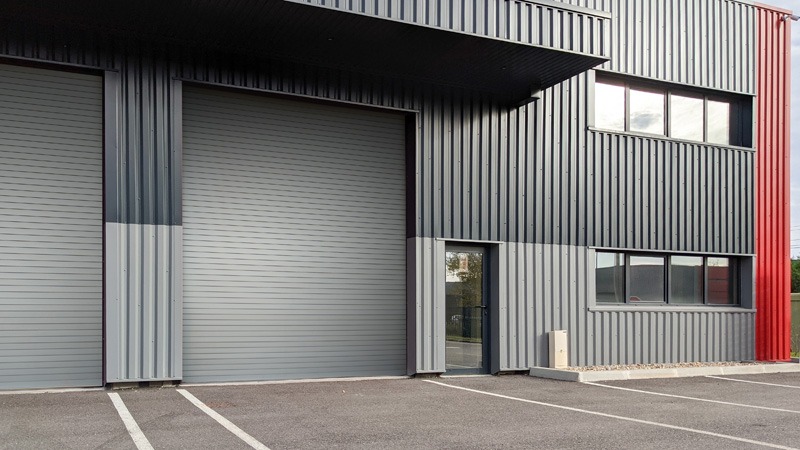
In data centres, energy-efficient overhead sectional and rolling steel doors are common features at ground-floor loading docks, service entrances, and upper levels, providing access for equipment installation and maintenance. To specify doors with the high-level performance required in these areas, it helps to understand how they are designed and which features enhance their effectiveness. (See Figure 1 and 2, page 16).
Energy-efficient overhead sectional door components
- Exterior steel skin
- Interior steel backing
- Section joints with continuous thermal breaks
- Foamed-in-place polyurethane foam
- Polyvinyl chloride (PVC) vinyl bottom weather seal
Insulated rolling door components
- Hood
- Curtain
- Guides
- Bottom bar
High-performance features of overhead sectional doors
Energy-efficient overhead sectional doors used in data centre applications are engineered as integrated assemblies, with each component contributing to thermal performance, airtightness, durability, and reliable operation. Using a 3-m-wide x 3-m-high (10-ft-wide x 10-ft-high) sectional door as a representative example, the following features demonstrate the performance capabilities of sectional doors and how manufacturers optimize individual components to meet the demanding requirements of large exterior openings.
Steel skins and structural strength
As a first step to specifying a superior, energy-efficient insulated sectional door, specify a 76.2 mm (3 in.) thick section. The construction typically uses a steel exterior, an interior steel backing, and a heavy-duty steel end stile. This combination creates a rigid, secure section capable of resisting impacts and wind loads. The robust steel construction also supports the door’s insulation system by maintaining the consistent section geometry essential for preserving thermal integrity.
Foamed-in-place polyurethane insulation
At the core of the door, foamed-in-place polyurethane insulation is injected between the steel skins, expanding to fill the entire section cavity. This process eliminates voids and bonds the insulation directly to both steel layers, creating a continuous thermal barrier. As a result, doors can achieve R-values of up to 27 when tested in accordance with Door & Access Systems Manufacturers Association (DASMA) TDS-163, U-factor and R-value for Residential and Commercial Garage Doors, supporting temperature control at the building perimeter.
Section joints with continuous thermal breaks
Section-to-section joints are a critical area for thermal loss in sectional doors. Advanced joint designs use tongue-and-groove profiles with continuous foam thermal breaks that interrupt metal-on-metal contact between sections. This approach significantly reduces thermal bridging through the joints and helps maintain consistent insulation performance across the full height of the door.
Low U-factor assembly performance
While R-value measures insulation within the panel, U-factor evaluates thermal transfer across the entire door assembly. By combining foamed-in-place insulation, thermally broken joints, and tight section construction, energy-efficient sectional doors can achieve U-factors as low as 0.16 in accordance with DASMA 105, Test Method for Thermal Transmittance of Doors. This low U-factor indicates strong overall resistance to heat flow, which is especially important for large data centre openings.
Astragal and air infiltration control
At the base of the door, PVC vinyl bottom weather seals create a continuous, flexible seal against the floor. This design accommodates minor surface irregularities and limits uncontrolled air leakage at one of the most vulnerable points in the opening. When combined with tight section tolerances and perimeter sealing, these doors can achieve air infiltration ratings of 2 L/s·m2 (0.40 cfm/ft2) or less, meeting the requirements of the 2015 International Energy Conservation Code (IECC) (Section 402.5.2).
Wind reinforcement
For large doors exposed to exterior pressures, wind reinforcement options, known as struts, are available to meet design pressures up to 2.5 kPa (52 psf). These struts help maintain section alignment and sealing under load, preserving both structural integrity and thermal performance.
Code compliance and climate versatility
When all these features are present in a sectional door, they can achieve compliance with the 2015 IECC, including meeting U-factor requirements of 0.37 or less for Climate Zones 1 through 8 (Section C402.4).
For data centres across Canada, these features help ensure sectional doors contribute meaningfully to energy efficiency, environmental stability, and long-term operational reliability.
Where insulated rolling doors raise the bar
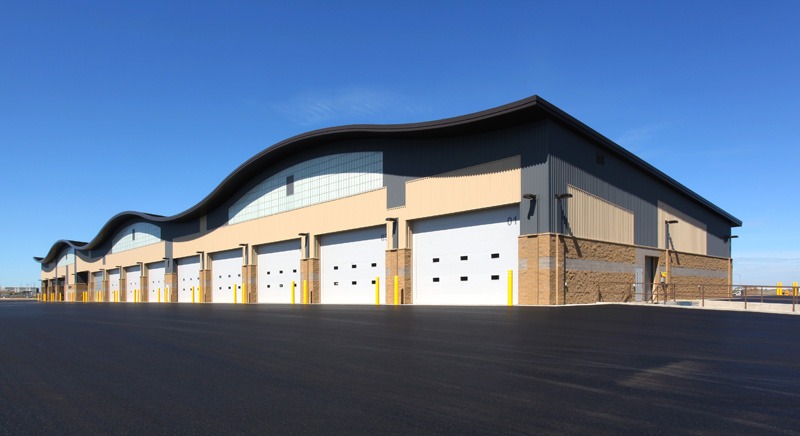
Insulated rolling steel doors often serve a different role than sectional doors in data centres, offering a compact, vertically coiling solution for exterior openings where saving space, durability, and environmental control coexist. Commonly used at upper-floor openings, these doors are designed to deliver consistent thermal and air-sealing performance while reliably serving personnel who access them from greater heights. Using a 4.89 m (16 ft) wide by 3.05 m (10 ft) high door as a representative example, the following features illustrate how manufacturers engineer insulated rolling steel doors to meet these requirements.
Standard steel insulated curtain construction
The curtain is formed by interlocking steel slats that roll vertically to open and close the door. In insulated rolling steel doors, the curtain uses a double-wall design, sandwiching insulation between the interior and exterior steel layers. In traditional rolling doors, this construction provides a natural thermal bridge that must be addressed to protect energy efficiency.
Thermally broken insulated curtain construction
Manufacturers improve curtain performance by pairing insulation with a low-conductivity chlorinated polyvinyl chloride (CPVC) backer. Insulative materials provide consistent thermal resistance, while the CPVC backer interrupts metal-to-metal contact (thermal bridging) within the slat assembly. This configuration reduces thermal transfer across the curtain surface while maintaining the strength required for large exterior openings and rugged operating conditions.
Low U-factor full-assembly performance
Overall energy efficiency depends on how the entire door assembly performs. Through integrated insulation, thermal breaks, and perimeter sealing, insulated rolling steel doors can achieve full-assembly U-factor ratings as low as 0.532 when tested to DASMA 105 standards. This low U-factor reflects reduced heat flow across the entire opening, an important consideration for data centres that rely on stable interior temperatures.
Thermally broken guides
The vertical guides that retain and align the curtain are a common source of thermal bridging in rolling door assemblies. Advanced designs incorporate thermal breaks within the guide construction, interrupting conductive paths at the door perimeter. When paired with integrated perimeter seals, thermally broken guides help reduce heat loss, limit air infiltration, and maintain pressure balance at the sides of the opening.
Patented perimeter sealing systems
Air infiltration can undermine both temperature and humidity control, particularly at large exterior openings. Insulated rolling steel doors address this with engineered perimeter sealing systems that create a continuous seal along the guides, hood interface, and bottom bar. These systems allow doors to achieve independently tested air infiltration rates of less than 1.5 L/s·m2 (0.3 cfm/ft2), meeting the requirements of ASHRAE 90.1 and IECC 2021.
Insulated hood design
The hood encloses the curtain and protects the operating mechanism from weather and debris. When insulated and properly sealed, the hood also limits heat loss at the top of the opening, where warm air naturally accumulates. This detail contributes to overall assembly performance and helps maintain consistent interior conditions.
Quiet and compact
Insulated rolling doors operate smoothly and quietly while withstanding frequent cycling and environmental exposure. Their compact coiling design conserves interior space, making them well-suited for upper-floor loading bays and service areas with limited space.
Like overhead sectional doors, insulated rolling doors demonstrate how manufacturers have advanced individual features to produce more effective, higher-performing assemblies.
Leveraging manufacturer knowledge and support
Specifying sectional and rolling steel doors for data centres is a complex task that requires balancing environmental control, energy efficiency, operational reliability, and security. To simplify the process, specifiers should seek a manufacturer that uses advances in materials science and engineering and provides specification support, such as AutoCAD drawings, performance data, and direct consultation. With the right manufacturer and the right doors in place, data centres can maintain stable interior conditions, optimize energy use, and operate reliably for years, supporting the growth of data centre construction in Canada.
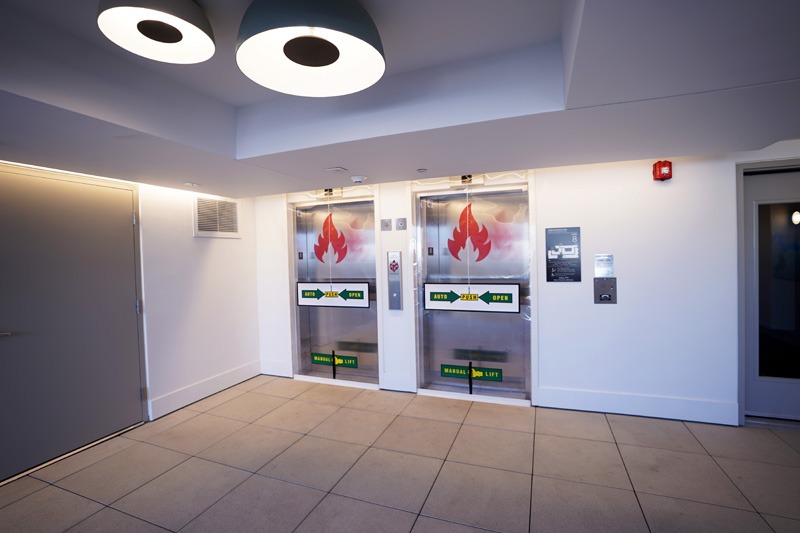
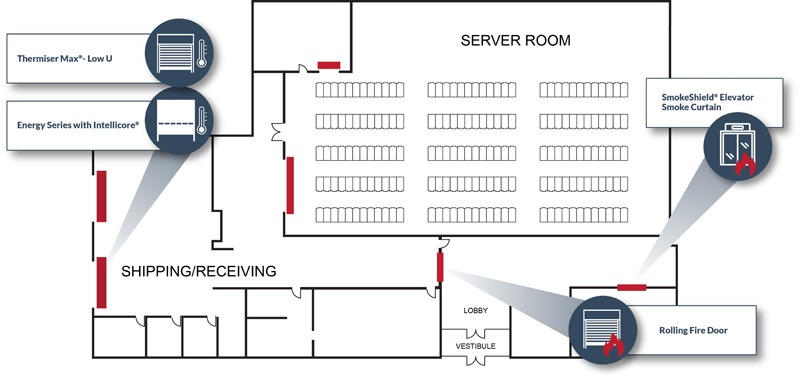
Seal openings on elevators in this data centre block smoke spread in multi-floor data centres, maintaining clear paths for occupants and first responders.
Author

Heather Bender, director of commercial product marketing at Clopay Corporation, leverages 17 years of experience in manufacturing and building materials. Excelling in product management, she adeptly handles product inception to commercialization. Her role involves finding unique solutions for building owners and designers, highlighting her strategic and innovative approach to complex industry challenges. She can be contacted at hbender@clopay.com.
Sign up for our weekly newsletter
Construction Canada weekly newsletters give the latest AEC industry news for those who build, design, engineer, specify, renovate or operate in the built environment.
Products & Services

Read the Latest Issue