Redefining smart: How AI is shaping the next era of building design
For years, the conversation around smart buildings has centred on connectivity. Cameras, access control, HVAC, lighting, and energy systems were networked, with the expectation that more data would naturally lead to better building performance. Yet many owners and operators now oversee environments where information is plentiful but actionable insight remains difficult to extract.

The issue is no longer whether buildings can collect data—it is whether they can interpret it to support timely, confident decisions. As facilities grow larger and more complex, operational teams often find themselves navigating multiple dashboards, investigating disconnected alerts, and manually piecing together context. A building may be fully connected yet lack the awareness needed to respond effectively to real-world conditions.
Artificial Intelligence (AI) is helping reshape this dynamic by enabling data to be analyzed as it is generated rather than after the fact. What is becoming clearer is that intelligence is not simply layered onto a building once construction is complete. It is heavily influenced by choices made much earlier in the process—by owners, designers, and engineering teams—from how systems are specified and integrated to the quality, consistency, and reliability of the data those systems produce.

Several emerging technologies are supporting this shift, not as standalone features, but as design tools that shape how buildings interpret and act on information. Connectivity establishes the foundation, but a building’s ability to support informed decision-making depends on how deliberately that foundation is structured.

When systems connect but do not communicate
On paper, many modern buildings appear fully integrated. Systems are connected, networks are robust, and data is continuously generated. Yet once occupied, these same environments often behave less like cohesive ecosystems and more like collections of independent technologies.
The root of this disconnect often lies in how building design and delivery projects are organized. Mechanical, electrical, life safety, security, and automation systems are typically delivered within clearly defined scopes that emphasize individual performance.
While this approach simplifies procurement and co-ordination, it can leave operational teams without a unified view of building activity.
Instead of the building providing clarity, people are left translating signals across platforms. Patterns that span multiple systems remain difficult to detect, and response strategies tend to follow isolated alerts rather than broader conditions.
Greater visibility emerges when data is allowed to move across these boundaries. Approaches supported by open platform architectures, systems designed to share data through standardized interfaces, and cross-system analytics, which interpret information from multiple technologies, are enabling a more holistic understanding of building conditions. With that shared perspective, teams can begin to see not only what is happening but also how events relate to one another across the environment.
Buildings that achieve this level of awareness rarely do so by accident. More often, integration was treated as a design priority from the outset rather than a technical step near project completion. Allowing systems to communicate, however, is only the beginning. The next challenge is ensuring that this shared data can be interpreted quickly enough to inform real-world decisions.
From data capture to intelligent insight
As expectations for responsiveness grow, attention is shifting toward how intelligence is distributed throughout a building. The rise of edge-based analytics, which analyze data directly on devices such as cameras and sensors rather than relying on centralized platforms, reflects a move to process information closer to where it is generated.
Analyzing conditions at the point of capture allows environments to respond with greater immediacy. In settings where timing can influence outcomes, including health-care facilities, transportation hubs, and large campuses, this localized interpretation strengthens both operational continuity and safety.
Yet speed alone does not guarantee better decisions. For intelligence to be actionable, the data itself must be organized in a way that systems can interpret. When devices produce structured metadata, descriptive data that converts raw inputs into searchable information such as occupancy patterns or movement flows, networks can be designed around meaningful insight rather than sheer data volume. Using metadata brings forth results in more efficient bandwidth use and infrastructure that scales more predictably as demands evolve.
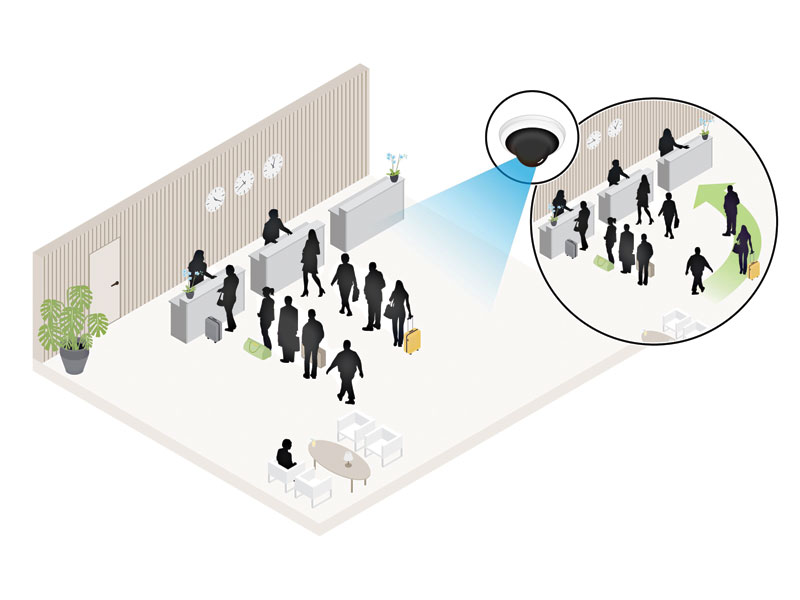
For example, in a multi-tenant office environment, metadata derived from video analytics can help identify recurring congestion points in shared corridors or lobby areas. Rather than relying on anecdotal feedback, building teams gain measurable insight that can inform layout adjustments, traffic flow strategies, or scheduling decisions. Over time, visibility supports environments that are not only more efficient, but better aligned with how occupants actually use the space.
Keeping certain forms of intelligence closer to the source can also support stronger cybersecurity strategies by limiting unnecessary data movement. As digital risk becomes inseparable from building performance, these architectural choices carry growing weight. But where intelligence resides is only part of the equation. Its effectiveness ultimately depends on the quality of the information behind it.
Buildings generate enormous amounts of information, yet volume alone does not create understanding. What supports better decisions is data that arrives in a form systems can interpret. This is where structured metadata becomes particularly valuable, providing a shared language through which technologies can communicate. Over time, this clarity allows operational strategies to evolve from reactive responses to more informed, proactive planning. Rather than relying on assumptions, building teams can identify emerging patterns, anticipate needs, and refine performance in ways that support both immediate operations and long-term resilience.
Designing for this level of intelligence requires looking beyond the presence of devices and considering the usefulness of the information they produce, as environments that generate well-structured data tend to adapt more easily as priorities shift and operational expectations grow.
Designing for adaptability
As building intelligence matures, interoperability is taking on new significance. Systems that cannot share information inevitably limit what AI can reveal, regardless of their individual sophistication.
Frameworks built on open platforms and open application programming interfaces (APIs), application interfaces that allow different technologies to exchange data without being locked into a single vendor ecosystem, enable structured information to circulate across security, facilities, energy, and automation environments. The result is a more unified operational perspective and greater flexibility to incorporate emerging tools over time.
From a life-cycle standpoint, adaptability is less about predicting every future requirement and more about preserving the ability to respond when needs inevitably change. Buildings designed with interoperable foundations tend to remain relevant longer, while those shaped by closed ecosystems may discover that what once felt efficient gradually narrows their options. As a result, design decisions that prioritize openness today often determine how effectively a building can evolve tomorrow, with operational priorities that were once managed separately starting to intersect in ways that were previously difficult to recognize.
Intelligence, trust, and integrated performance
Safety, sustainability, and occupant experience have traditionally been treated as parallel objectives, each supported by its own technologies and workflows. Shared intelligence is revealing how closely these priorities are linked.
In many facilities, this convergence is already shaping how spaces are monitored, managed, and optimized on a daily basis. Capabilities such as scene intelligence, a form of computer vision that enables systems to interpret activity within a space rather than simply record it, and computer vision analytics, which analyze visual data to identify patterns and anomalies, allow buildings to understand behaviour with greater context. Routine activity can be distinguished from situations that may require attention, helping teams respond with precision while also informing energy management strategies, such as HVAC and lighting adjustments, that align system performance with actual occupancy instead of fixed schedules.
Insights into how spaces are used often lead to adjustments that improve comfort, accessibility, and functionality, allowing the building to operate less like a static asset and more like a setting that can recalibrate itself. As buildings take on a more responsive role, confidence in the underlying technology becomes essential. Technologies such as secure device identity, encrypted data handling, and secure-by-design architectures help ensure that intelligent environments remain both innovative and accountable, particularly when these considerations are embedded early in the design process.
A quiet redefinition of smart
As AI becomes more embedded in building operations, the meaning of smart building continues to evolve. Connectivity laid the groundwork, but intelligence is what allows that foundation to perform under real-world pressures.
Buildings designed to support shared data, distributed analytics, and interoperable systems are better positioned to interpret activity, anticipate patterns, and guide informed responses. What emerges is not simply a smarter building, but one better equipped to support the continuous decisions that shape performance over its lifetime. In that light, a smart building is no longer defined by the sophistication of the systems it contains, but by how effectively it supports the countless decisions that influence how the environment functions every day it is in use.
Author

Sophie Laplante is the business development manager, public safety, Canada at Axis Communications, Inc. Laplante’s causes are civil rights and social action, education, the environment and health, and science and technology. She is ASIS Quebec Chapter, vice-president.
Sign up for our weekly newsletter
Construction Canada weekly newsletters give the latest AEC industry news for those who build, design, engineer, specify, renovate or operate in the built environment.
Products & Services

Read the Latest Issue