Ceilings that connect: Baffles unify design and manage acoustics
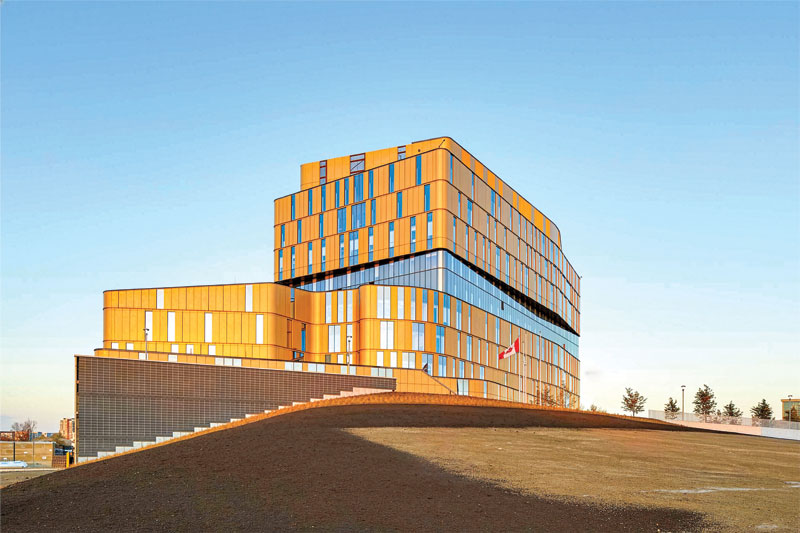
York University’s Markham Campus building in Markham, Ont., stands in stark contrast to the red-bricked symmetry usually seen on college campuses. The new 37,161 m2 (400,000 sf) academic centre is a satellite of the university’s main campus in Toronto. Positioned strategically at a transit hub within the urban community, the Markham Campus serves 4,000 students and offers various academic programs, all housed within a 10-storey building.
At first glance, visitors probably would not guess that the Markham Campus building belongs to a university, a deliberate decision by project architect Diamond Schmitt, a leading North American firm in post-secondary construction. Unlike traditional campuses with separate buildings dedicated to individual disciplines, Diamond Schmitt designed the Markham Campus to rise instead of expand outward, housing all its multidisciplinary, multifunctional teaching and learning spaces within a single vertical structure.
To unify the campus and landscape, exterior and interior, and form and function, Diamond Schmitt aimed for an interior design strategy that could act as a unifying element throughout the building. A co-ordinated ceiling approach—merging metal baffles with acoustic infill and polyethylene terephthalate (PET) felt blade and wave baffles—became one of the main methods used to enhance visual continuity and acoustic comfort across the interior spaces.
Working closely with the ceiling contractor, Oakdale Drywall & Acoustics Ltd., and a ceiling systems supplier, the team put in place a solution that balances visual continuity, durability, and acoustic performance throughout the building.
Creating cohesion with ceiling design
The York University building in Markham has become a striking focal point in the city, characterized by wavy, multidimensional floors, each showcasing random patterns of vertical glass and bronze-anodized aluminum cladding. Its unconventional design injects energy into the exterior, with rounded details that echo the curves of the surrounding grounds known as Campus Green.
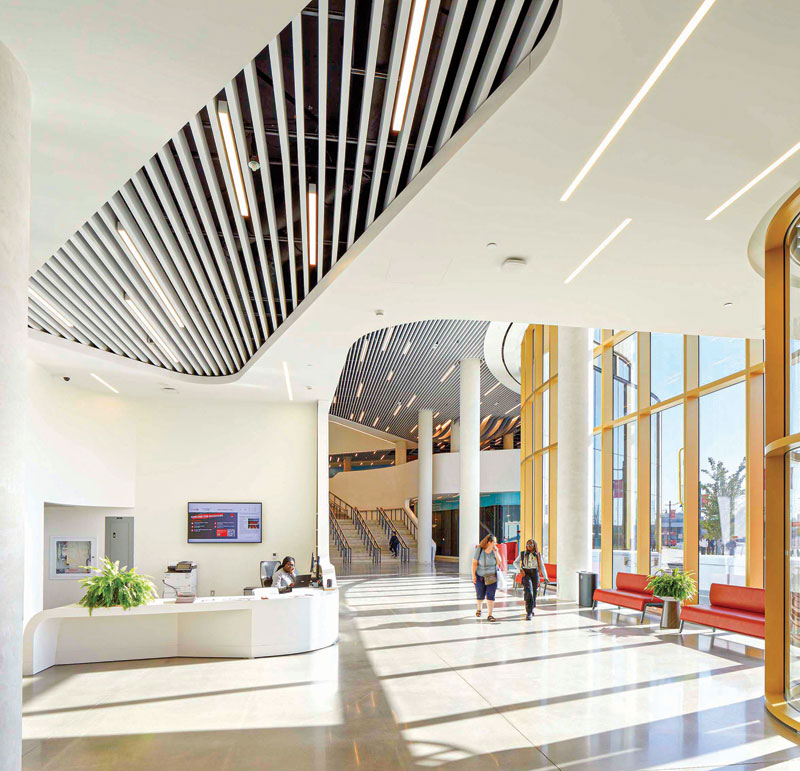
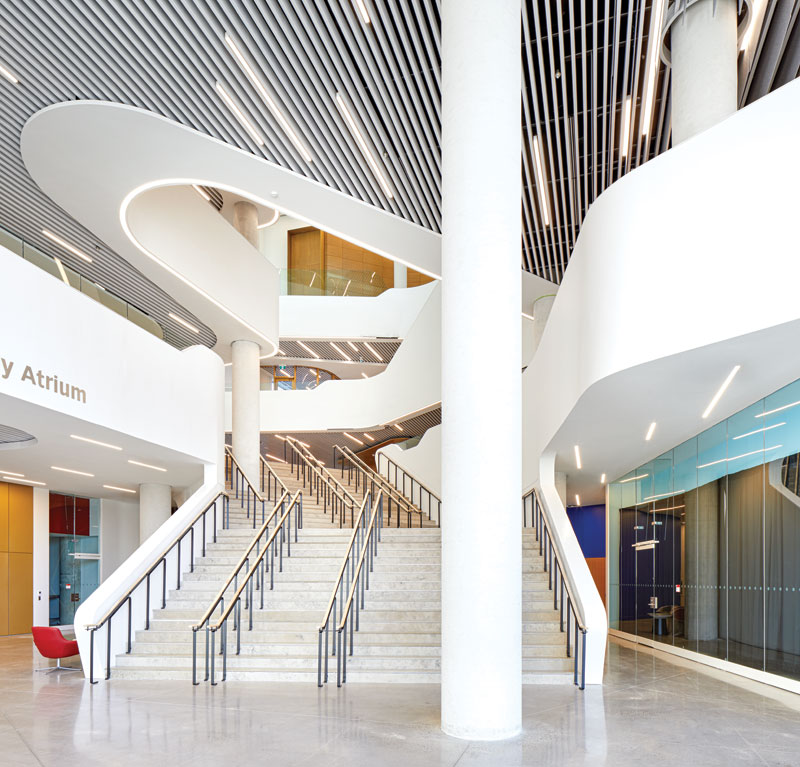
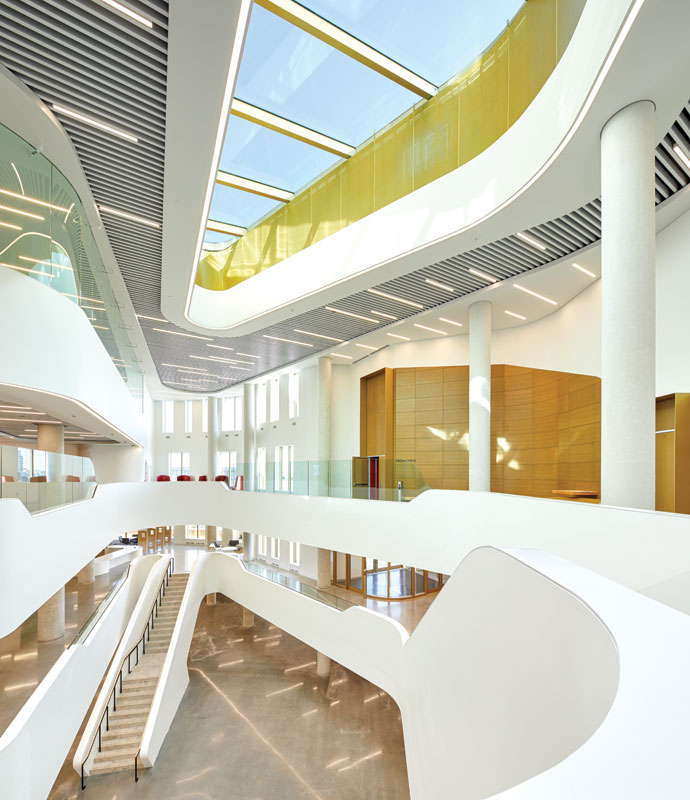
That same flowing harmony extends to the interior, where a multistorey atrium acts as the focal point. Lower levels accommodate student programs and services, while upper floors host academic programs arranged by subject and wing.
Associate Architect Marcin Ludwik Sztaba, a member of the Diamond Schmitt team, recalls the complexity of the design: “The challenge lay in how we connected the landscape and spatial experience within the building. The building itself evolves and grows, changing shape as it rises in elevation. We needed to create a connective tissue within the building.”
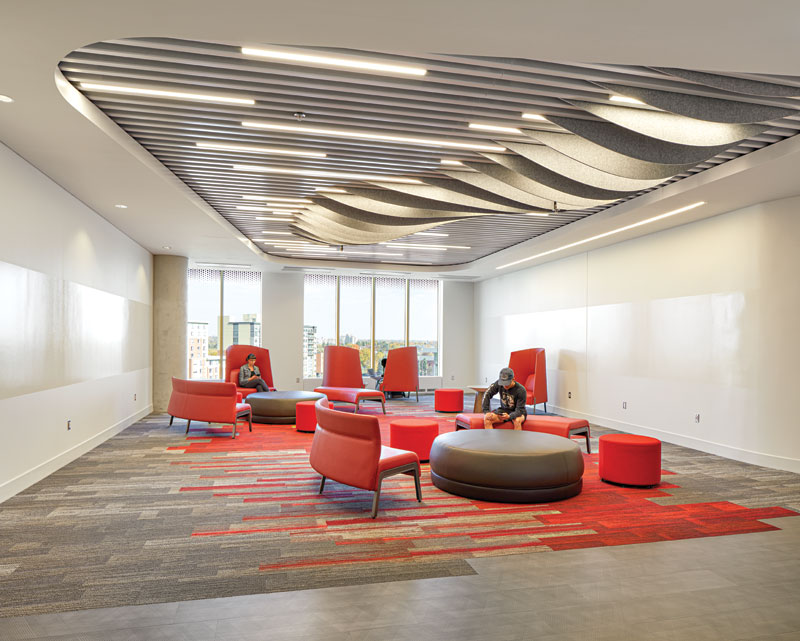
To create that “connective tissue,” designers co-ordinated ceiling systems throughout the building to establish wayfinding and define space. Dramatic baffle patterns, created through the use of colour and shape, add a logical visual pathway of movement and light, while also helping to control sound travel across open floors and concourses.
Achieving cohesion within the large interior space posed unique challenges when selecting ceiling systems that met both esthetic and acoustic needs. Diamond Schmitt project manager and senior associate Jessica Cheung explains, “We chose to use feature ceilings to demarcate public gathering spaces like student lounges, reception, and information areas. They’re markers that students and the community can see from a distance. These spaces tend to be more open and can be loud. So, the ceilings we implemented provide acoustic absorption as well.”
Before finalizing ceiling specifications, Cheung, Sztaba, and the design team identified several project requirements that the ceiling contractor and the chosen ceiling products and systems needed to meet.
Appearance
To support the architect’s forward-thinking esthetic and intentionally move away from traditional academic symmetry, the ceiling systems needed to be highly adaptable, offering a broad range of sizes, shapes, and colours that would complement the overall interior design palette.
Acoustics
The building’s expansive multistorey atrium with high ceilings, open stairways, and concourses required high-performance sound control to reduce echo and improve speech clarity. To meet this challenge and define each space both visually and acoustically, ceiling baffles needed to meet multiple technical criteria, including baffle thickness and spacing to achieve a noise reduction coefficient (NRC) rating of 0.85 and maintain acoustic comfort in the dense, vertical environment.
Adapting to lighting, HVAC, and other ceiling components
The ceiling baffles and their suspension systems had to allow the architect flexibility in controlling the number and placement of lighting features. The system also needed to accommodate HVAC components and other mechanical elements housed within the ceiling area without disrupting the visual effect and continuity of the ceiling design. Lastly, it had to provide easy access to the ceiling space for routine maintenance.
Installation
Early in the design process, Diamond Schmitt evaluated several ceiling system options for the project. However, the ceiling contractor, Oakdale Drywall & Acoustics Ltd., identified several concerns with this approach. One was that each baffle manufacturer had a different attachment system, which would make it difficult to create the smooth, fluid visual effect that was central to the building’s interior design. Similarly, changing attachment systems throughout the building could slow the installation, as the installers would have to switch tools and processes between products. Co-ordinating three different manufacturers to supply what would amount to 24 km (15 miles) of linear ceiling products also risked delays, since lead times and delivery schedules varied among manufacturers. To achieve visual cohesion, simplify installation, and protect the construction schedule, the team ultimately selected a single ceiling
system supplier.
Simplifying the specification strengthened the design
Ultimately, the project team chose a single ceiling system supplier to meet the esthetic, acoustic, and logistical requirements of the design while making installation and co-ordination easier.
Esthetics and acoustics
In large, open areas such as the atrium and main circulation zones, the project employs a visually cohesive system of metal baffles with acoustic infill. The baffles enhance durability and ease of maintenance while achieving an NRC rating of 0.85, helping reduce echoes and improve speech clarity. Esthetically and practically, their light-reflective finish enhances daylight distribution throughout the interior.
In student study areas and lounges, PET polyester felt wave baffles add warmth and visual rhythm in select ceiling spans. Tested according to ASTM E1264 and C423, their 12 mm (0.5 in. nominal) thickness and 152 mm (6 in.) spacing contribute to acoustic absorption while reinforcing the building’s sense of movement and order. The felt wave baffles feature a gentle downward-curved profile that breaks up the linear visual plane created by the metal baffles and helps define smaller zones within open floors. Like the metal baffle systems, the felt wave baffles achieve a 0.85 NRC while introducing visual texture to study areas.
One simple suspension system
Selecting a single ceiling system supplier allowed both the metal and PET felt baffle ceilings to be installed using a unified suspension system. Installers depended on a consistent system of 610-mm (24-in.) cross tees, 24-mm (0.93-in.) main tees, and 12-gauge galvanized carbon-steel hanger wire, removing the need to switch tools or methods between ceiling types. Sourcing all ceiling components from a single supplier simplified delivery co-ordination and helped keep the project on schedule.
Convenient ceiling access
The ceiling’s attachment hardware allows easier access to the plenum for building staff to service lighting, HVAC, and other mechanical parts. To reach the space between the baffles and the ceiling structural slab above, facility managers simply unhook the baffles from the suspension system, reducing the time and effort required for routine maintenance.
The ceiling systems used in the project meet fire performance standards, including CAN/ULC-S102.0. PET felt options are also available with up to 60 per cent post-consumer recycled content, no volatile organic compounds (VOCs), and environmental product declaration (EPD) and GREENGUARD Gold certification.
A beacon of modern academia
From initial concept to community focal point, the York University Markham Campus building embodies a bold new approach in post-secondary architecture. By translating the surrounding urban landscape into interior design strategies and employing ceiling systems to enhance wayfinding, acoustic comfort, and spatial clarity, the project demonstrates how vertical campus design can foster collaborative learning environments within dense
urban areas.
“Seeing the Markham Campus go from what we imagined it to be to becoming what it actually is speaks to the way the contractor and ceiling manufacturer understood our vision and helped us achieve it,” says Sztaba. “It’s great to go from virtual to reality without losing the intent and key features of what we set out to do.”
Author

Steve McElwee is the founder and CEO of Maxxit Group, a Toronto-based provider of architectural ceiling, wall, and interior solutions across North America. Before founding Maxxit, McElwee gained extensive experience in the millwork industry, developing a strong foundation in architectural detailing, specialty finishes, and the practical demands of construction, while delivering customized solutions for architects, designers, and contractors.
Sign up for our weekly newsletter
Construction Canada weekly newsletters give the latest AEC industry news for those who build, design, engineer, specify, renovate or operate in the built environment.
Products & Services

Read the Latest Issue