Mass timber meets modern medicine
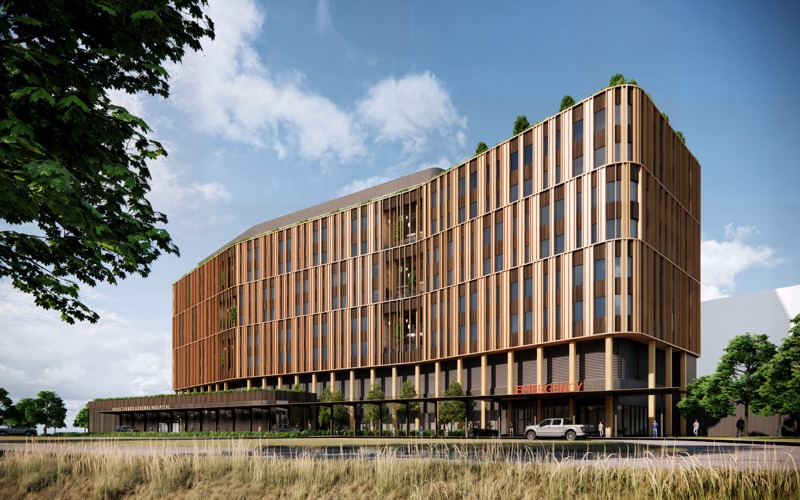
For decades, hospital design has prioritized efficiency and low capital cost. This approach has implications for the health-care sector’s sustainable performance and overlooks the built environment’s critical role in healing.
The building industry is the world’s largest source of carbon emissions, and hospitals are among its highest emitters. In Canada, the nation’s health-care system accounts for 4.6 per cent of its greenhouse gas (GHG) emissions.1,2 While measures such as electrification and heat pumps are reducing the operational carbon footprint of hospitals, a corresponding effort towards reducing the embodied carbon is needed to reduce the typology’s overall environmental impact.
Mass timber offers a viable solution for cost-effectively aligning environmental and patient priorities at a time when health-care infrastructure faces increasing pressure due to an aging national population, rising development costs, and the climate crisis. Compared to concrete or steel, mass timber can expedite construction and improve patient outcomes. Further, it is produced with minimized fossil fuel consumption and even sequesters carbon. According to the U.S. Department of Agriculture’s (USDA’s) Forest Products Laboratory, mass timber can reduce a building’s embodied carbon by 22 to 50 per cent for typical projects.3 Due to health-care’s outsized carbon footprint, a more significant reduction is expected.
Despite these advantages, mass timber has yet to be widely adopted by health care, with Canadian building codes still precluding its use in most hospital settings. Revising codes requires advocacy and Canadian health-care owners and operators have yet to see the material as a viable method of construction.
To address this, KPMB Architects and British Columbia’s Provincial Health Services Authority (PHSA)—along with an integrated team of consultants, including Fast + Epp, Smith + Andersen, CHM Code Consultants, Hanscomb, Resource Planning Group, EllisDon, and AMB Medical Equipment Planning—recently designed a speculative mass timber study for an in-patient unit using Canadian programming and planning norms, codes, and standards. The undertaking was a practical and cost-effective response to the existing barriers.
Reconsidering capital costs due to improved outcomes and efficacy
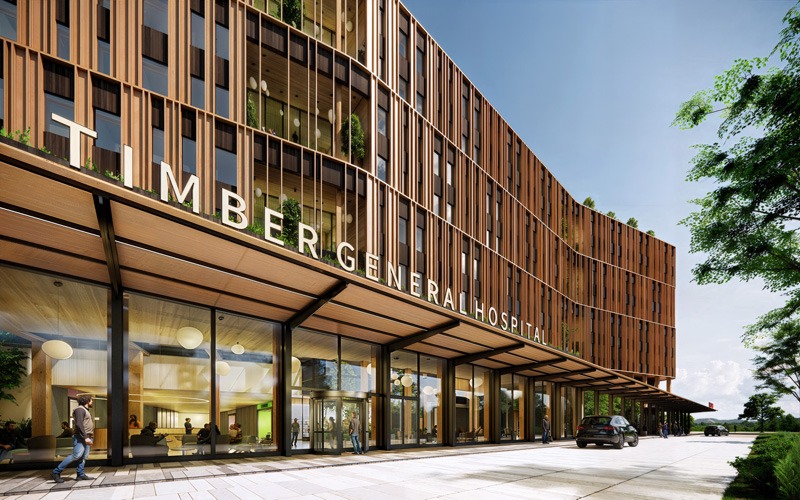
The current cost of mass timber construction is a major reason for the sector’s ongoing reluctance. Currently, mass timber adds approximately four to five per cent to the overall construction cost of a building.4 An additional complication, budgets for health-care facility design typically do not consider investments in operational efficacy—in this case, improved health outcomes—to justify innovation or improvement.
However, assessing only initial capital outlays offers an incomplete understanding of a building’s total cost. According to the Canadian Institute for Health Information (CIHI), the average annual cost of operating a hospital bed in Canada was $933,500 in 2024.5 The average cost of construction is $4 million.6 Over a 50-year period, the operational costs of a hospital bed will exceed the initial capital by a factor of 12. Offsetting the initial five per cent cost premium requires only modest operational improvements.
Decades of research in biophilic design have demonstrated that exposure to natural materials can positively impact health and wellbeing. According to a research study by Dr. David Robert Fell at the University of British Columbia in 2010, patients reported more positive healing experiences when wood was integrated into clinics and hospitals.7 For workers, studies suggest that wood surfaces improve concentration, mood, and productivity, perhaps by as much as five to seven per cent.8 It is reasonable then to expect that shortened inpatient stays and improvements to staff efficiency and wellbeing will cover the initial investment manifold.
Further, the current cost of mass timber construction is partly driven by a lack of industry familiarity. This will likely decrease over time, allowing owners and operators to better benefit from one of mass timber’s primary advantages: accelerated construction. By enabling the prefabrication of components and requiring reduced foundations due to timber’s lighter weight, mass timber can reduce on-site labour and accelerate the completion of a building’s structure and enclosure—thereby reducing costs.
Addressing the structural limitations of mass timber
Despite common misconceptions, mass timber is a strong, durable, and safe building material. Historically, concerns regarding its use have focused on fire safety. However, third-party engineering tests have shown that mass timber is inherently fire-resistant when designed correctly.
The primary structural barriers to mass timber’s use in hospitals are its structural span and vibration control requirements. The nominal span of a typical acute care planning grid is 9 m (30 ft), which is optimized for concrete and steel systems and is larger than what mass timber favours. While deeper timber beam depths can achieve similar spans, this increases overall building height and, by occupying more space, complicates MEP distribution in service-heavy buildings. Similarly, while additional columns can improve stiffness to help meet the vibration requirements for surgery and diagnostics, they also complicate medical planning grids and can impede the large, flexible floorplates favoured by hospitals.
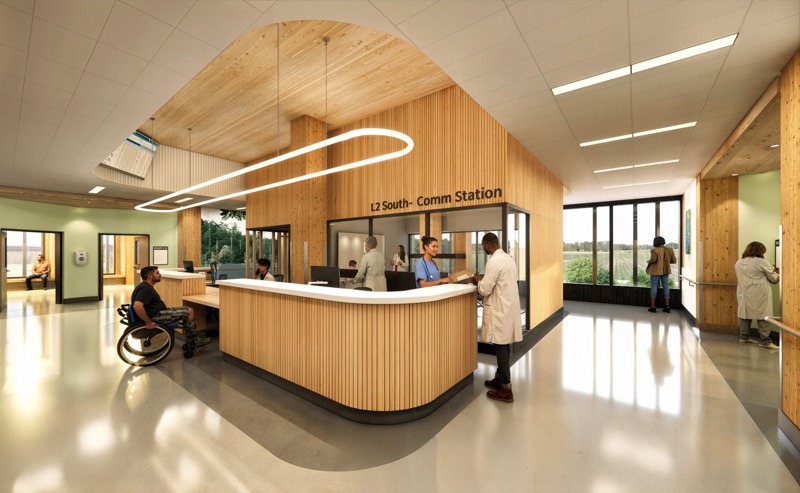
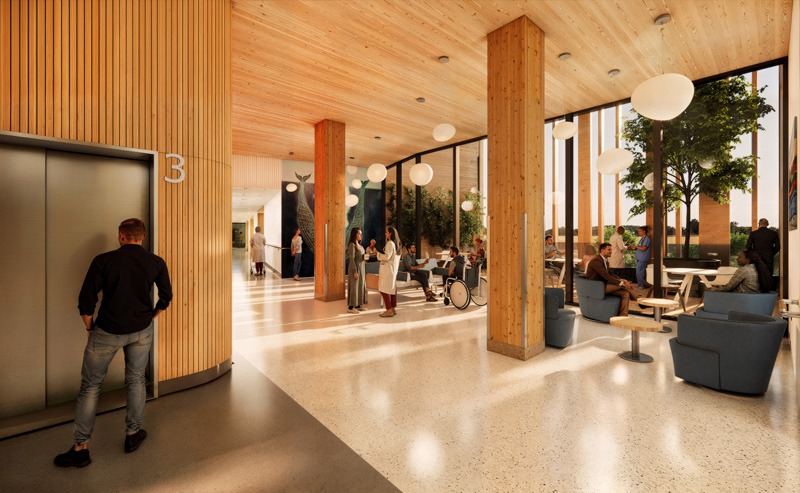
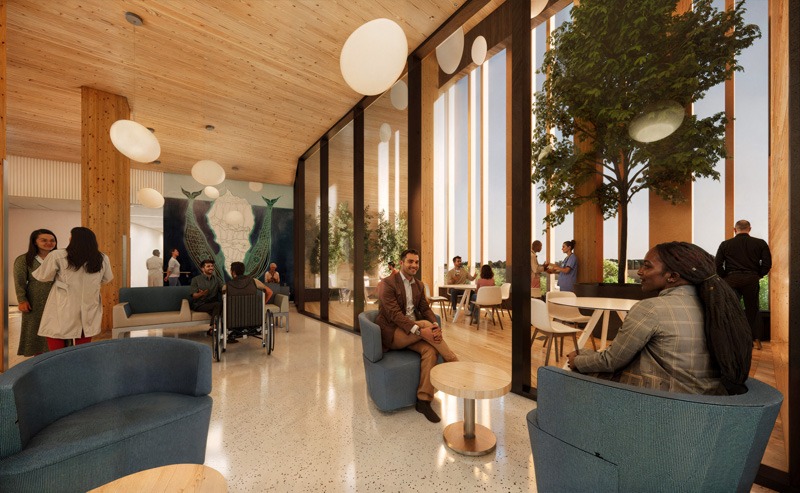
Intended as a proof-of-concept, the mass timber in-patient unit study addresses both vibration control and grid requirements without increasing envelope costs or introducing dropped beams. The design features a composite frame of interior and exterior glulam mass timber (GLT) columns, exterior cross-laminated timber (CLT) girders, and composite steel-and-concrete interior girders. This hybrid system is a cost-effective solution to the material’s structural limitations, while still maximizing the physiological benefits of exposed timber. Even when accounting for its hybrid nature, an early life-cycle assessment of the proposed inpatient design revealed a 63 per cent reduction in embodied carbon when benchmarked against an equivalent reinforced concrete design.
Most effectively employed in hospitals when integrated with other building systems, mass timber should be applied to areas where patients and staff spend considerable time, and its biophilic benefits offer the greatest return. Conversely, high-criteria areas that have transient occupants and specific needs are less suited to its use. These include operating rooms with size requirements, sterile processing areas with strict moisture control needs, or imaging facilities with stringent stiffness and vibration limits.
Infection prevention and control
Health-care standards continue to recommend against the use of cellulose-based materials, such as wood, in clinical areas. A porous material that cracks and checks with age and can abrade and splinter with wear, wood has been widely considered a sanitation risk in health-care environments.
Despite this perception, microbial and virologic studies are beginning to present a more nuanced picture of wood’s capabilities, with some research suggesting that wood surfaces in health-care settings may outperform materials that are accepted for widespread use, such as stainless steel and plastics.9, 10
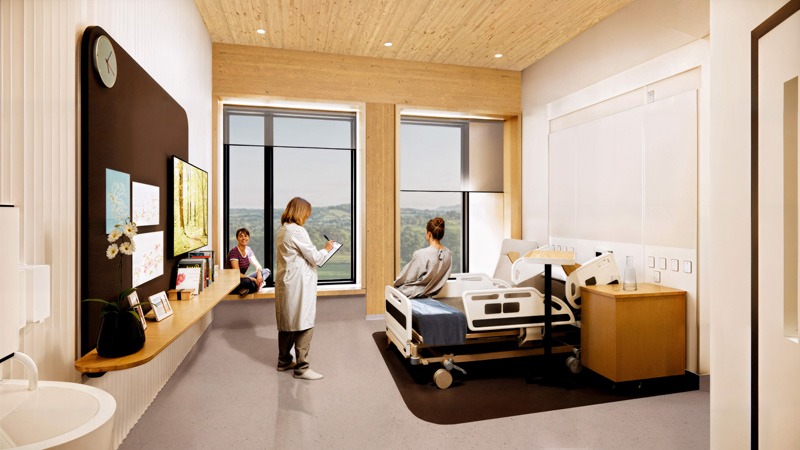
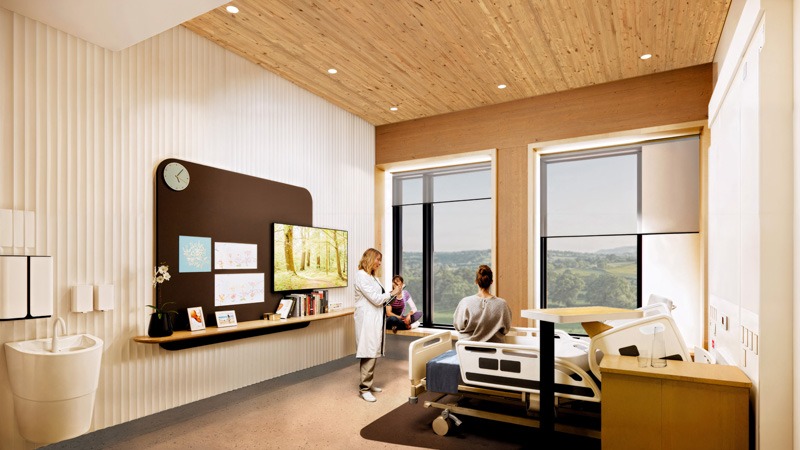
As assistant professor Dr. Mark Fretz, co-director of the University of Oregon’s Institute for Health in the Built Environment, summarized in 2025: “People generally think of wood as unhygienic in a medical setting. But wood actually transfers microbes at a lower rate than other less porous materials such as stainless steel.”11
Also notable is wood’s ability to absorb moisture from the air, suggesting it may effectively help limit the transfer of respiratory diseases in hospital settings.
From a construction and durability perspective, industry concerns regarding mass timber include its susceptibility to rot and mould. Hospitals have many wet areas and buildings are exposed to the elements while under construction. While legitimate concerns, these can be successfully managed with comprehensive planning during construction, environmental controls, the installation of leak detection sensors, the careful detailing of plumbing penetrations, and the use of local membranes.
Construction speed and modularity: An ancillary benefit
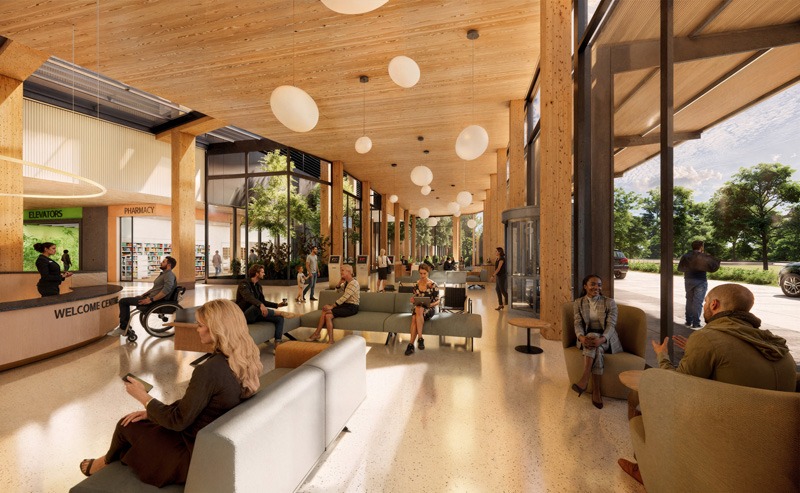
Canada’s health-care industry is showing a renewed interest and focus on modular design and construction. The principal interest in such is reducing design and approval times and construction costs. While not a specific focus of the KPMB-PHSA-led study, mass timber also excels in this area. It better capitalizes on computer-modelling driven (BIM) design and fabrication than either steel or concrete and can quicken construction scheduling by 20 to 30 per cent.12
Going forward: Addressing building code restrictions
Across Canada, building code limitations on mass timber buildings are being rewritten, largely due to market pressure from the residential and commercial sectors. Consequently, residential mass timber towers can now be built up to 18-storeys and with a footprint far beyond all but the largest hospitals.
From a technical perspective, and with modest alternate compliance measures, the groundwork to obtain approval for a B2 mass timber high-rise structure appears to exist. Despite structural limitations, modest construction premiums, and concerns related to performance and durability, mass timber can be an effective alternative to conventional hospital structures when applied to select patient areas and used in conjunction with other building systems. It can improve patient outcomes and staff productivity and reduce embodied carbon—factors that also contribute to the material’s increasingly compelling business case.
Canada’s health-care facilities must evolve to meet the needs of modern medicine, climate responsibility, and human-centred care. Of all the materials at our disposal, mass timber offers the best opportunity to meet these needs head-on. What is required now is for the marketplace to drive regulatory change.
Notes
1 See Eckelman, Matthew J., Jodi A. Sherman, Alexander J. G. MacNeill, “Life cycle environmental emissions and health damages from the Canadian healthcare system: An economic-environmental-epidemiological analysis,” PLOS Medicine, vol. 15, no. 7 (2018), e1002623.
2 Read Vogel, Lauren, “Canada’s health system is among the least green,” CMAJ, vol. 191, no. 48 (2019), E1342.
3 Refer to Puettmann, Maureen, Francesca Pierobon, Indroneil Ganguly, Hao Gu, Chen Chen, Shanshan Liang, Russell Jones, Gregory Maples, and Jeff Wishnie, “Comparative LCAs of Conventional and Mass Timber Buildings in Regions with Potential for Mass Timber Penetration,” Treesearch (2021),
4 Based on a cost study prepared by Hanscomb as part of a speculative mass timber in-patient unit design developed by KPMB Architects and British Columbia’s Provincial Health Services Authority (PHSA), with contributions from an integrated consultant team including Fast + Epp, Smith + Andersen, CHM Code Consultants, Resource Planning Group, EllisDon, and AMB Medical Equipment Planning.
5 Derived from analysis of data published by the Canadian Institute for Health Information (CIHI), based on annual acute care hospital operating costs divided by the number of acute care beds; CIHI does not present this figure in this aggregated form.
6 Calculated from an average Canadian current market construction value of $20,000 CAD per m² and a nominal allocation of 200 m² per bed.
7 See Fell, David Robert, “Wood in the Human Environment: Restorative Properties of Wood in the Built Indoor Environment,” University of British Columbia (2010).
8 Refer to Knox and Parry-Husbands, “Workplaces: Wellness + Wood = Productivity” (2018).
9 Read Mhuireach, Gráinne, Erin Fretz, Elliott Gall, Kevin Van Den Wymelenberg, Lindsey Stenson, Ryan Nortchutt, Anne Laguerre, Peter Horve, Leigh Dietz, and Susan Collins, “Effects of wetting events on mass timber surface microbial communities and VOC emissions: Implications for building operation and occupant well-being,” Frontiers in Microbiomes (2025).
10 Visit Munir, M., Pailhories, H., Eveillard, M., Irle, M., Aviat, F., Dubreil, L., Federighi, M., and Belloncle, C., “Testing the Antimicrobial Characteristics of Wood Materials: A Review of Methods,” Antibiotics (2022).
11 Read “UO study advances use of mass timber in hospital construction,” Oregon News (2025).
12 According to “Changes in modern building codes are creating even more opportunities to make mass timber structures a bigger part of the urban skyline,” American Wood Council.
Author
Chris McQuillan is a principal at KPMB Architects. He is leading the mass timber hospital tower study with Juan Martinez of British Columbia’s Provincial Health Services Authority (PHSA) and Lisa Miller-Way of CHM Fire.
Sign up for our weekly newsletter
Construction Canada weekly newsletters give the latest AEC industry news for those who build, design, engineer, specify, renovate or operate in the built environment.
Products & Services
Read the Latest Issue