
Sneak peek: Inside a university’s ‘living laboratory’
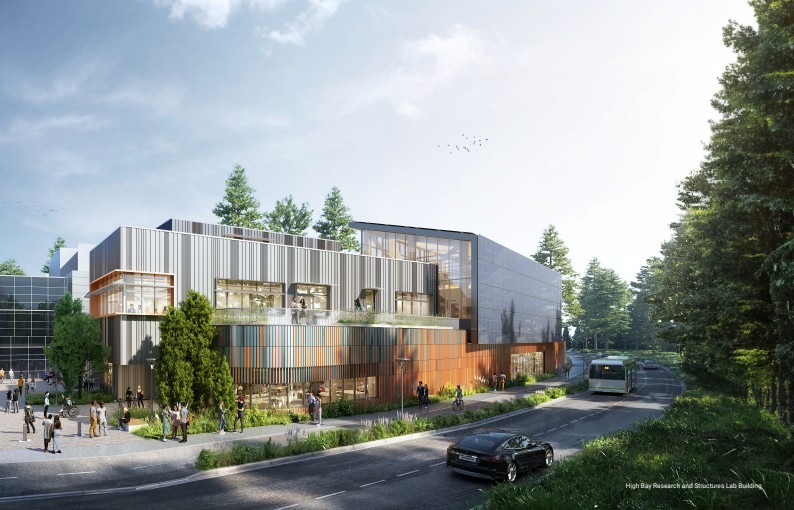
The University of Victoria (UVic) is expanding its civil engineering campus with two new net-zero, mass-timber buildings that reimagine how architecture can support teaching, research, and climate action.
Designed by DIALOG, the project includes a six-storey expansion to the Engineering & Computer Science building (ECSE) and a new, purpose-built High Bay Research & Structures Lab (HBRSL).
Together, the buildings are designed not simply as places to learn, but as fully instrumented “living laboratories,” playing an active role in enhancing the academic curriculum and ongoing climate research.
On-site green roofs, bioswales, and Indigenous planting systems further integrate landscape, biodiversity, and water management into the learning environment, redefining hands-on learning.
The ECSE expansion will add staff offices, collaboration spaces, and teaching and research laboratories, while the HBRSL is a stand-alone structure housing a double-height structural testing facility alongside advanced engineering labs.
Both buildings were developed through close collaboration with UVic’s Civil Engineering faculty.
Slated for completion later this year, the project has already achieved Zero Carbon Building accreditation and is targeting LEED Gold certification, in alignment with the Canada Green Building Council’s (CAGBC’s) Zero Carbon Building Standards and the International Living Future Institute’s (ILFI’s) Zero Carbon framework.
Sign up for our weekly newsletter
Construction Canada weekly newsletters give the latest AEC industry news for those who build, design, engineer, specify, renovate or operate in the built environment.
Popular Articles
-
1
-
2
-
3
-
4
-
5
Read the Latest Issue

- Two Methods of Collaborative Construction Delivery: Construction Management and Integrated Project
- Reducing a Billion Dollar Problem in Construction Through Correct Moisture Testing of Concrete
- Reducing a billion dollar problem in construction through correct moisture testing of concrete
- Message from the president | Message de la présidente : The role of product information in specification
- 💻 Author-led sessions on new CCDC documents